How Do You Read Gedmatch Dna Results
GEDmatch introduction
GEDmatch is a primarily free genealogy site that lets users upload their own autosomal Deoxyribonucleic acid test results and discover related individuals. Information technology was founded by Curtis Roger in 2010. The powerful GEDmatch Genesis tool finds matching segments of DNA in it's ane.3 million users regardless of which company the original data is from. Users can upload information from a broad variety of sites, letting people find family members even if one used 23andMe and the other used AncestryDNA. In that location are besides other Deoxyribonucleic acid tools that let you lot explore your ancestry.
1 of the major drawbacks of GEDmatch is that it is not designed for the novice user. That's what this tutorial is for: Nosotros'll walk you lot through how to sign up for free, upload your raw DNA data from other Dna testing sites, how to look at your ancestry, and explore your family relationships.
Is GEDmatch safe?
GEDmatch is not going to give you inaccurate medical information that may cause you lot to erroneously seek medical care as information technology isn't going to offer you whatsoever medical or wellness information at all. Information technology also does not tout itself as the nigh authentic and precise measure out of ethnicity. The admixture/heritage tools pull data from many unlike sources and your results volition vary depending on which project you select.
Before you commencement uploading your genetic data to random websites, you should know more than near who is receiving that data. GEDmatch is currently endemic by Verogen, a forensic genomics company. Verogen makes coin, in office, by allowing law enforcement to utilize their genealogy database to solve crimes. This might mean that your Deoxyribonucleic acid could help identify a victim of a criminal offence — or the criminal.
How to sign upwards
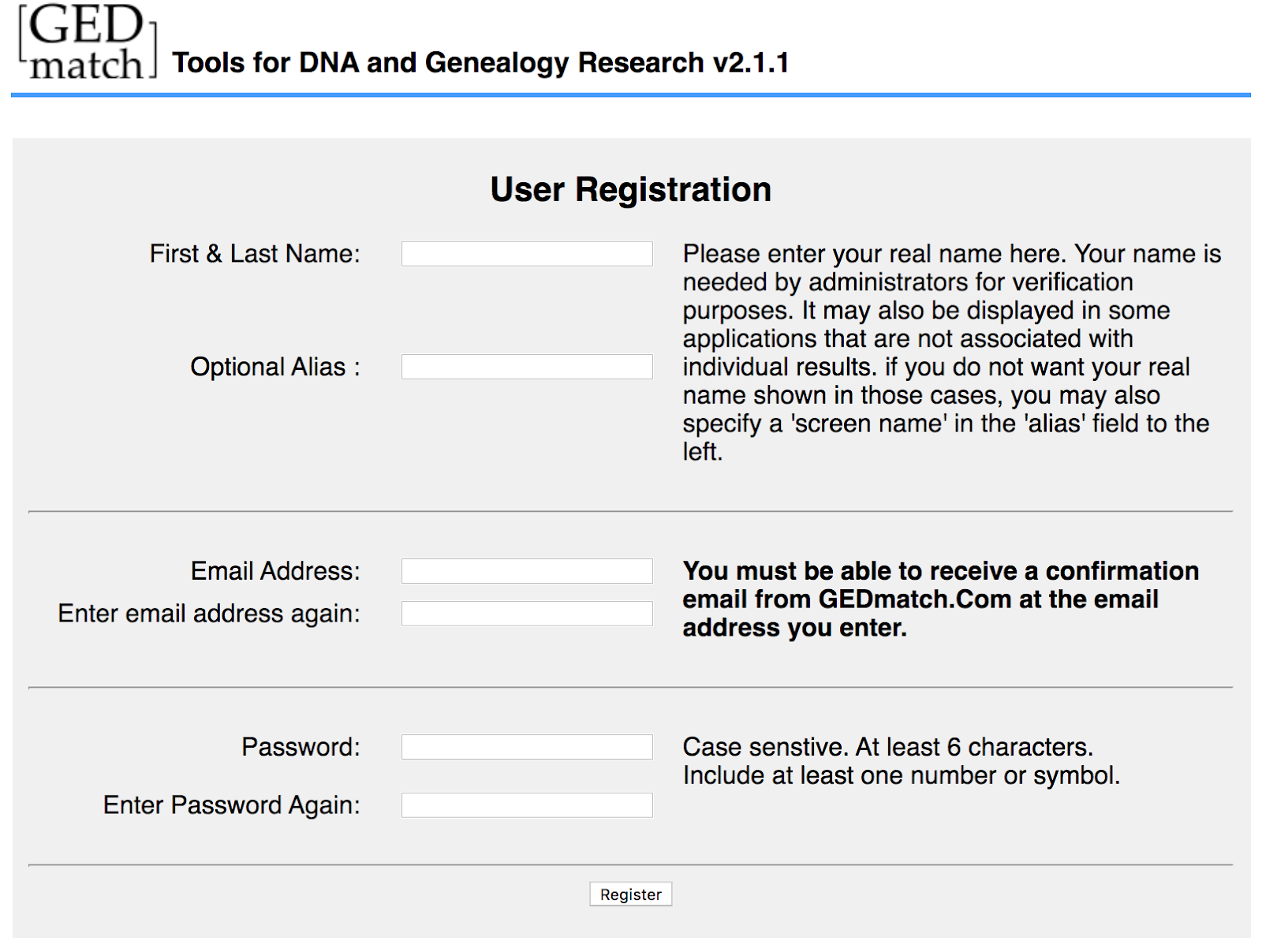
Registration is straightforward. Become to the registration page and fill in your name, alias if you'd rather your proper name non announced publicly, e-mail, and countersign. Your email and countersign will be your GEDmatch login.
The electronic mail needs to exist valid as GEDmatch volition send a validation code. Be aware that this e-mail will be visible to other users if you choose to employ the central one-to-many DNA matching tool. Although your real name is requested, this does not seem to be validated.
How to upload information to GEDmatch
GEDmatch does not offering DNA testing, merely interpretation of existing Deoxyribonucleic acid results. Therefore, you will need to download your data from whatever SNP based testing company you submitted a sample to. You can either search "how to download raw genetic data from" and the name of your testing company or become directly to the tutorials from Ancestry DNA, 23 and Me, or Family Tree Dna.
Depending on where your testing was done, you may download a unmarried file or a folder. This will likely be "gzipped" which makes it take upward less space but makes it so only a estimator can read information technology. To "unzip" information technology, and brand it readable by a human, on a Mac, double click on it or, on a PC, correct-click and click "unzip". You tin now open up information technology in WordPad or Excel.
GEDmatch will only accept what information technology calls "23andMe format". This differs from "Variant Call Format" or "VCF". GEDmatch will not have .vcf files. Probable yous will be able to directly download a file in 23andMe format. If yous are only able to download a VCF, check out this tutorial (scroll down to the part titled "Converting VCF Files to 23andMe Files").
GEDmatch will not have full exomes or genomes. They too recommend against uploading imputed data where a calculator has tried to judge what your DNA might have been in betwixt the SNPs that were actually tested. You should upload only raw SNP data.
GEDmatch will check if the file is in the right format and reject it if it'south not. If y'all want to check that the file is 23andMe format yourself you can open it in Wordpad or Excel. It will probable accept some lines at the top that commencement with a hashtag, these are ignored past the computer. The rest will look similar this:
# rsid chromosome position genotype
rs3094315 1 752566 AA
rs3131972 1 752721 GA
rs75333668 i 762320 CC
rsID is the name of the SNP, chromosome, and position are where the SNP is constitute, and genotype is what the SNP is at that position. There are two letters, one from each parent.
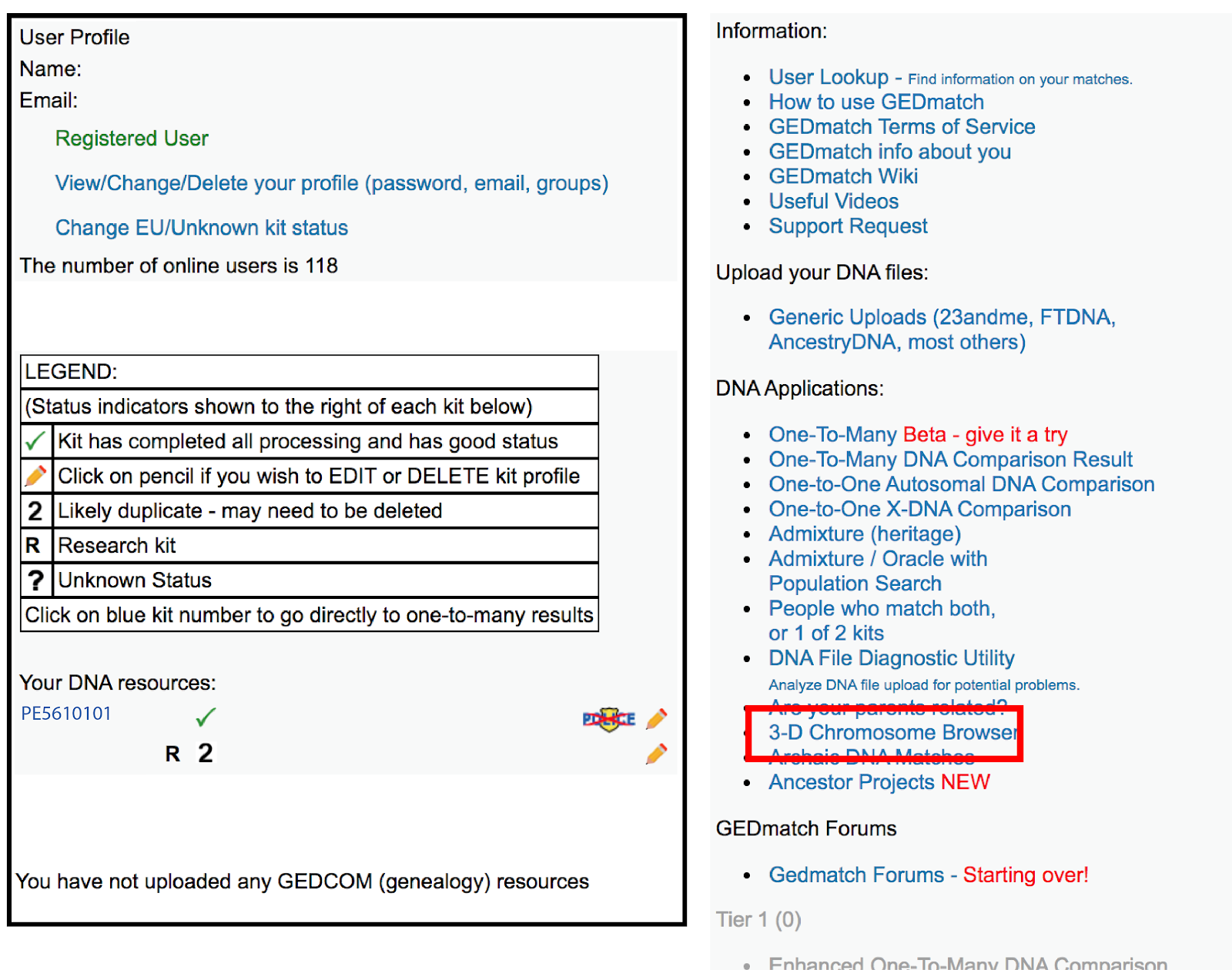
Now, y'all can upload your genetic information to GEDmatch. This button is on the correct-mitt side of the homepage, marked in the red box below, and says "Generic Uploads (23andMe, FTDNA, AncestryDNA, Living DNA and most others)".
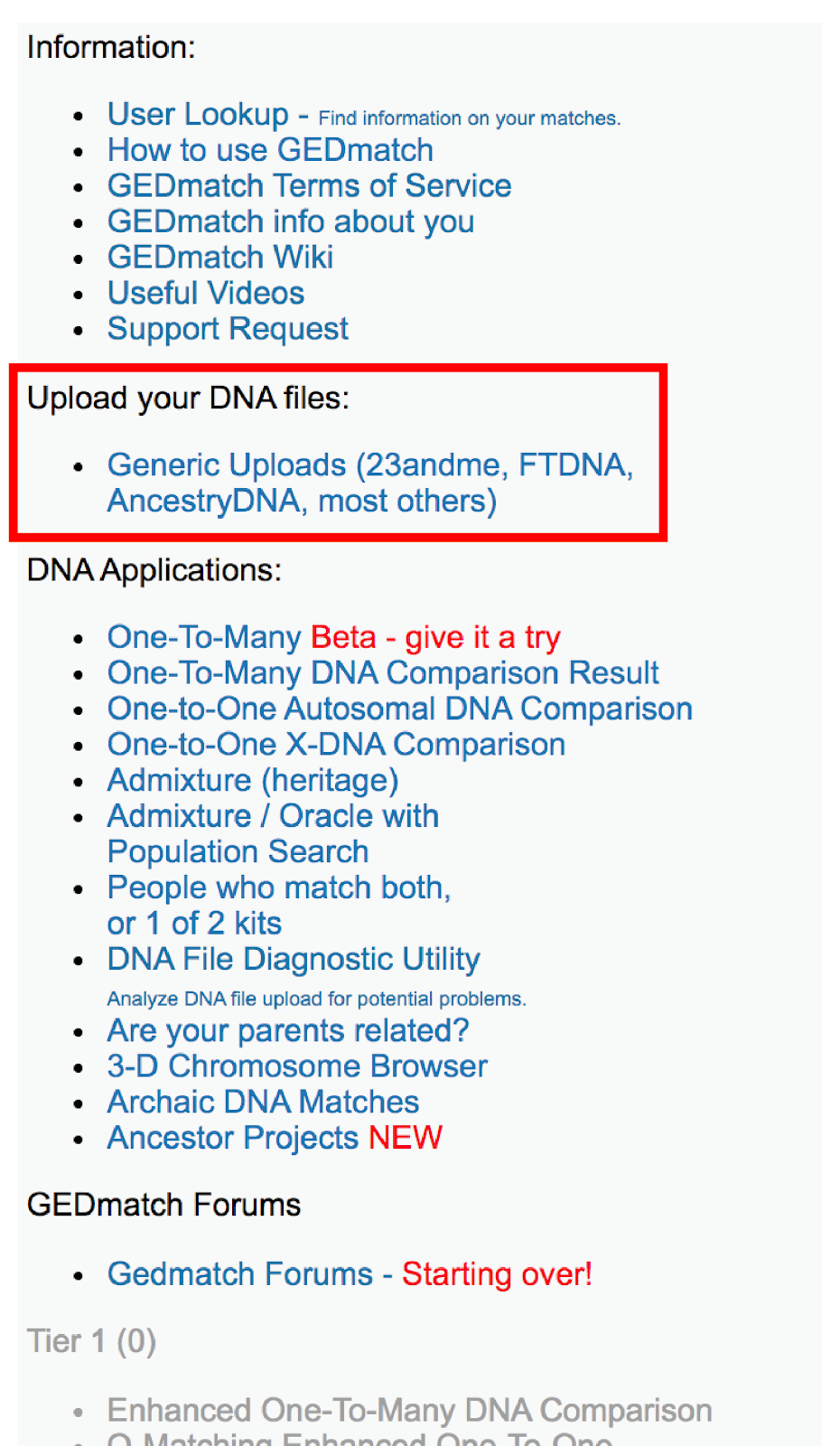
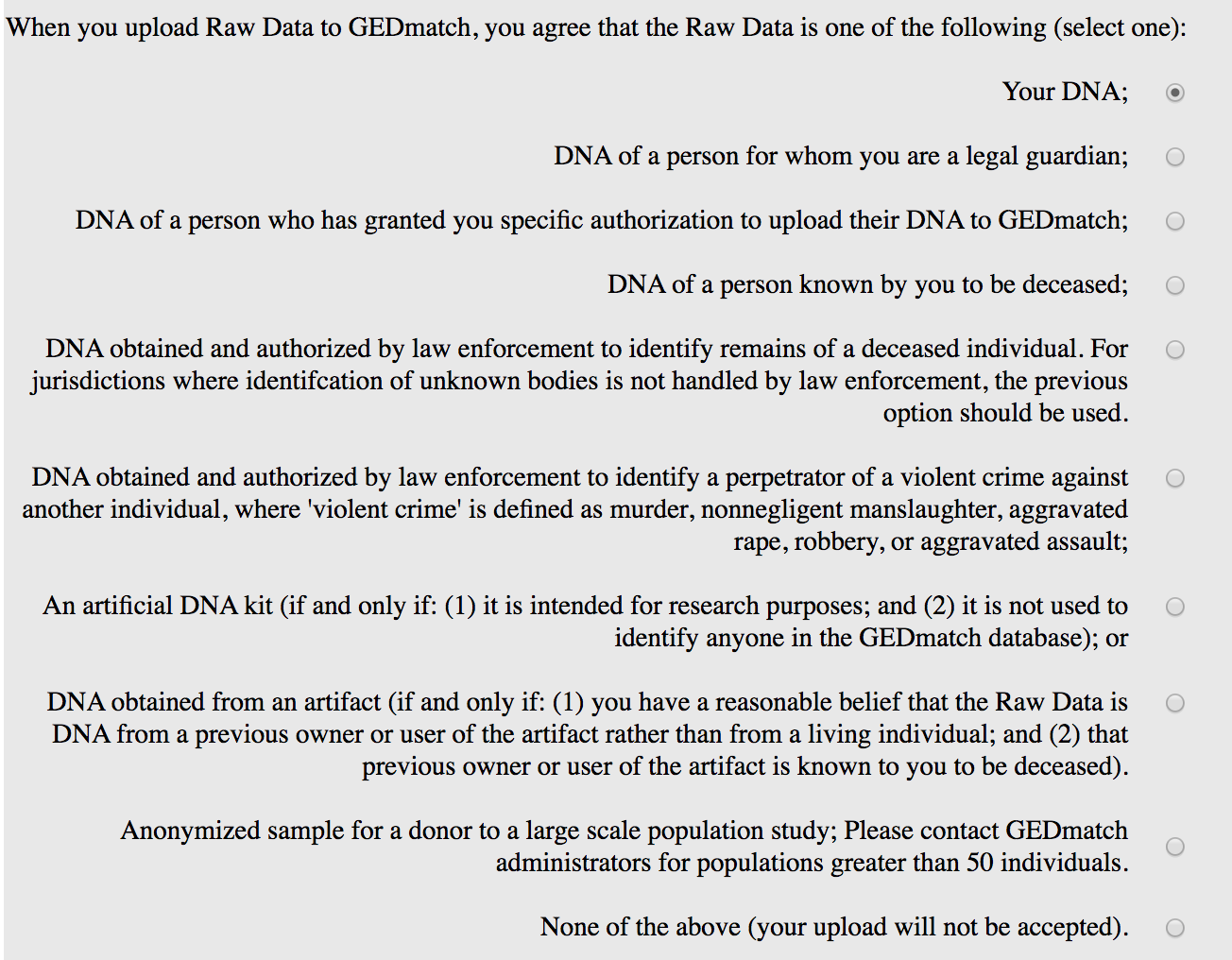
On the following page, it'south recommended to fill out as much data every bit you accept. However, the merely necessary boxes are a proper noun and that you lot click the radio button stating that you're authorized to upload the data (because information technology'due south yours, y'all have their permission, the person is dead, or y'all're police enforcement). Everything else is optional. If you don't know the answer, leave it blank.
The very last set up of questions is optional merely important to answer. This is asking for the privacy preferences for this Dna profile, also called a "Dna kit".
The default pick is "Opt-in" which volition let police force enforcement access your data for criminal searches. It's important to note that GEDmatch has been used to identify criminals past finding even distantly related family members. GEDmatch was used to solve the Golden Land Killer cold example by matching Deoxyribonucleic acid from the law-breaking scene to a third or fourth cousin.
I chose to "Opt-out" which lets me compare my kit to others and lets individuals who are not police enforcement observe me. Other options include research, which lets you see matches but does non let the matches see yous, or private, which volition non allow you to find family members using the Genesis tool merely volition let you use other ancestry tools.
Fifty-fifty if you opt-out or choose to keep the data private, GEDmatch will however turn the information over to law enforcement if a court subpoenas the data.
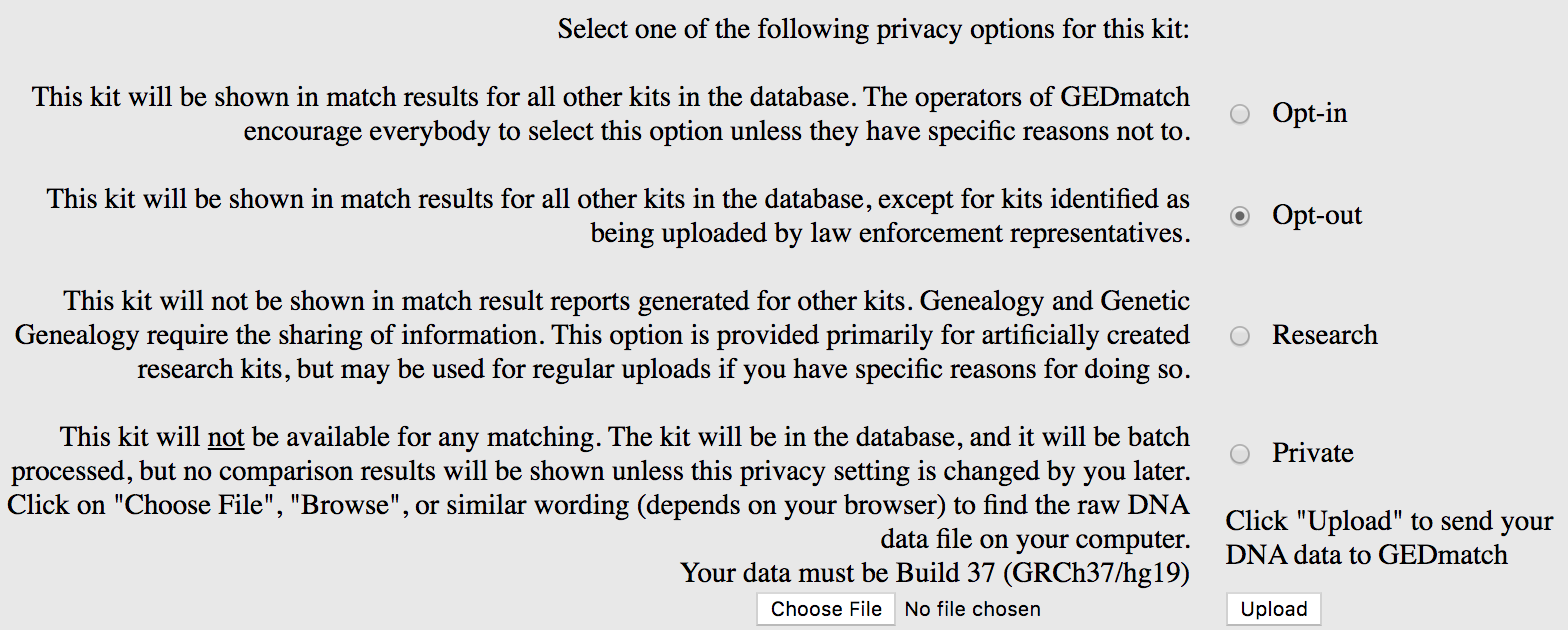
Click "Cull File", find the file on your calculator, and then click "upload". Once you've added your file, it may take several minutes for the upload to occur. Practice not exit the page or striking refresh. The time will depend on how large your genomic information file is and how good your upload speeds are. If it takes more than than x minutes, yous should attempt over again.
If your file is too big and boring to upload you lot can re-zip it. On a Mac, ctrl+click the file name and select "Compress". On a PC, left click, select "Send to" and select "Compressed (Zipped) Folder".
You'll then meet some large green numbers counting up, checking that each of your chromosomes was found in your file, and then it'll give you your "kit number". You'll demand this for all of the analysis on GEDmatch. Don't worry too much about writing it down somewhere condom, it'll show up on the abode page and you can copy and paste it from there.
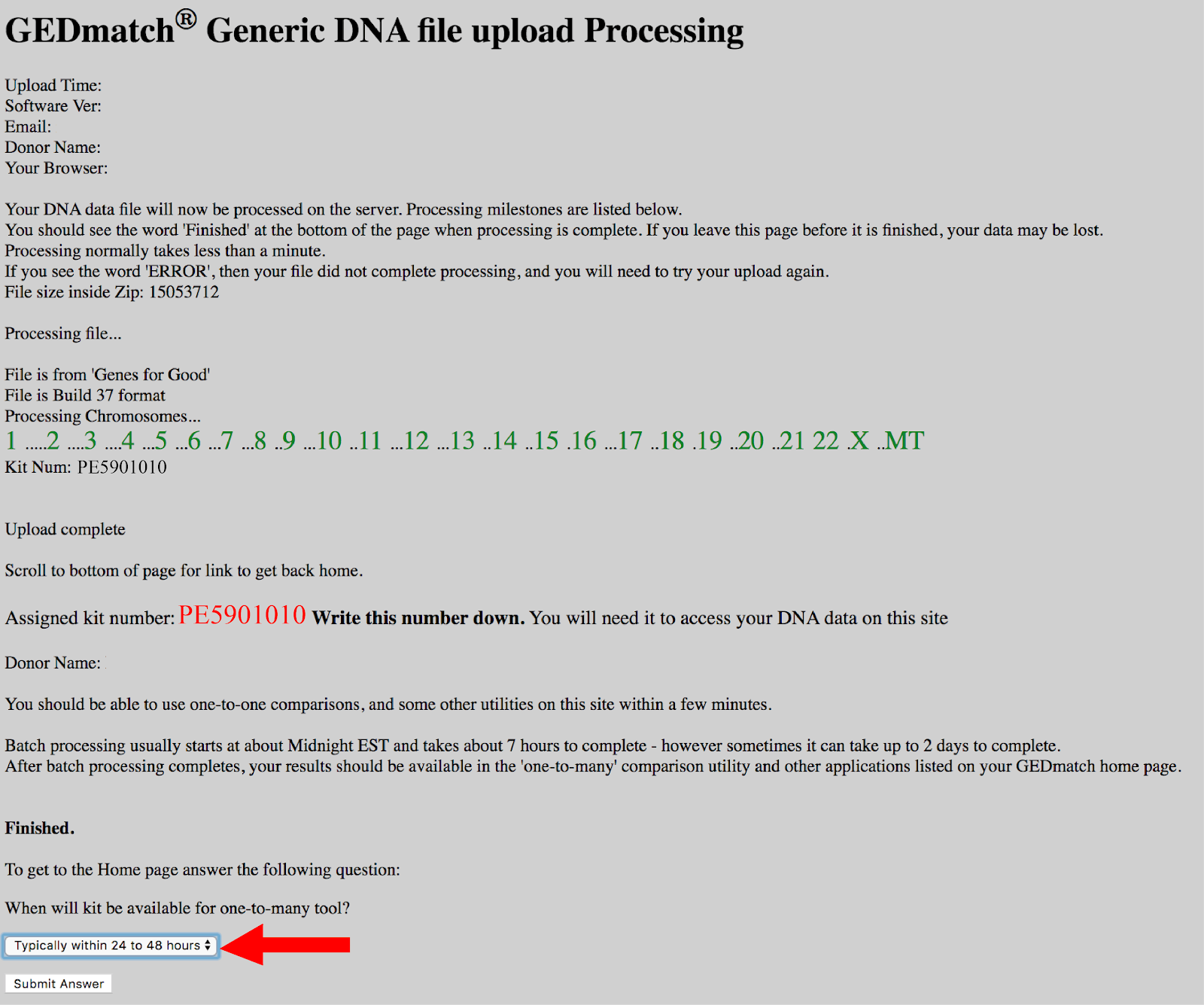
In order to go back to the habitation page, you lot'll demand to answer GEDmatch'south question, "When will my kit be bachelor for one-to-many tool?" with "Typically within 24 to 48 hours". This is the GEDmatch strategy for keeping yous from emailing them and asking why you can't discover your results nevertheless.
GEDmatch'southward 1-to-many tool takes a while to run because it has to compare your Deoxyribonucleic acid to the Deoxyribonucleic acid of all ane.three 1000000 users. Don't worry, though, there are other tools to play with while yous wait.
How to look at your Admixture/Heritage
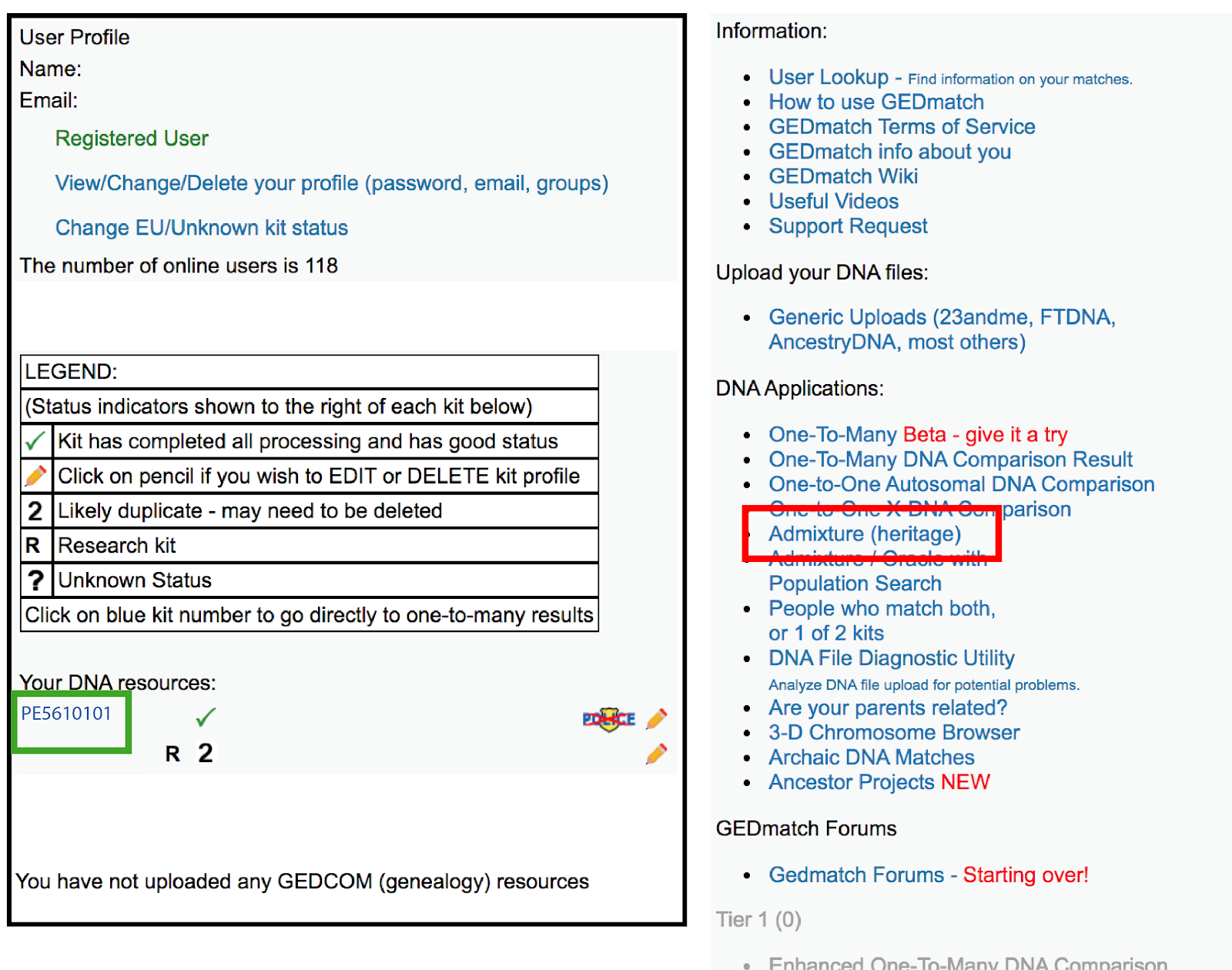
To look at your Admixture (heritage), you'll need to find your kit number. Mine is highlighted in the green rectangle on the left higher up. You tin write this down or just copy to paste it later. Then, click on "Admixture (heritage)" on the correct of the screen.
Admixture analysis works by matching chunks of your SNPs to a ready of references. Information technology's important that you're comparing to the correct set of references. Otherwise, the program might try to force a lucifer that isn't actually accurate, but information technology'southward the closest information technology has, and miss out on a match it could have fabricated.
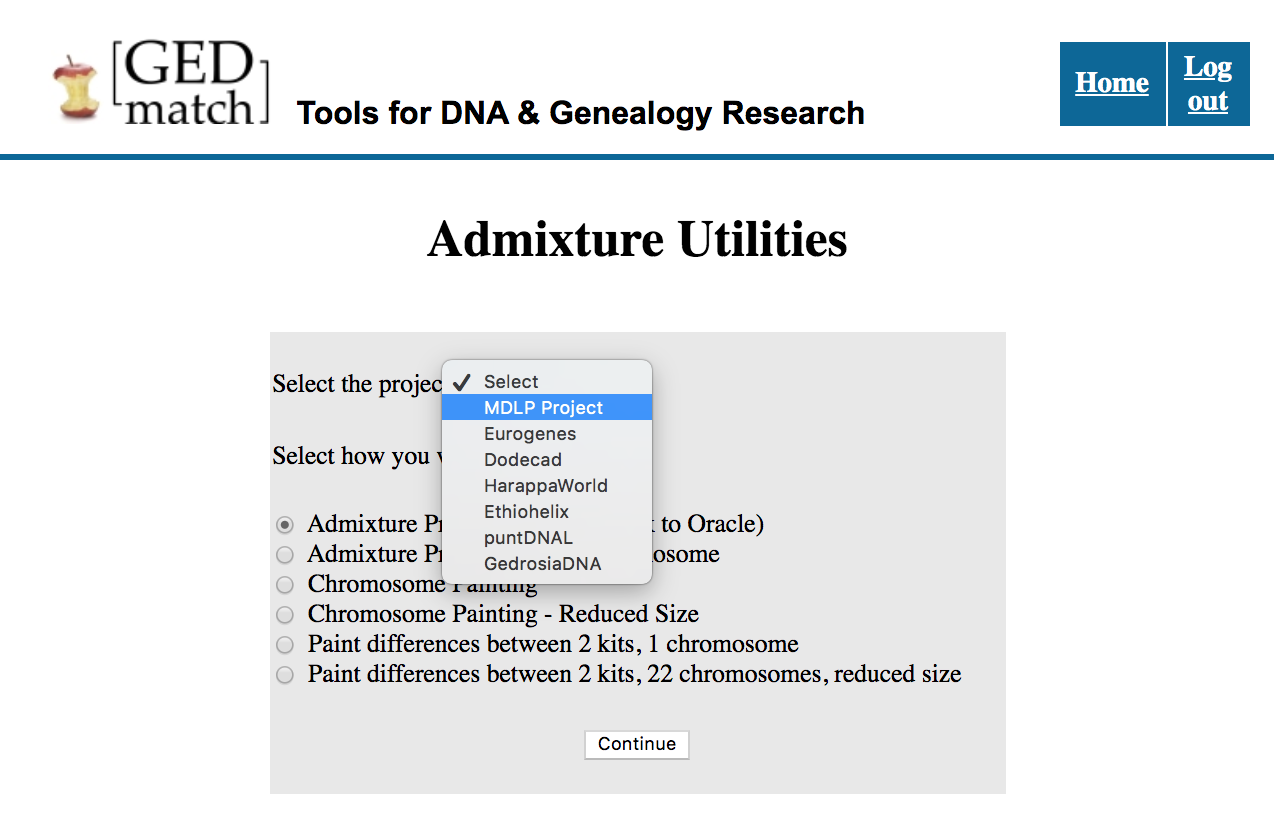
This spreadsheet contains a comprehensive list of each of the populations in each project.
MDLP is adept as a broad global calculator. Information technology pulls data from all around the earth. MDLP globe and MDLP earth-22 are useful for anyone wanting to get a broad expect at their ancestry. MDLp world-22 includes Pygmy, West-Asian, North European Mesolithic (an ancient Dna sample), Indo-Tibetan, Mesoamerica, Arctic-Amerind, Due south-America_Amerind, Indian, Due north-Siberian, Atlantic_Mediterannean_Neolithic, Samoedic, Indo_Iranian, East-Siberian, North-Due east-European, South-African, Due north-Amerind, Subsaharaian, East-South-Asian, Near_East, Melanesian, Paleo-Siberian, and Austronesian.
Eurogenes provides a effectively map of Europe with the Eurogenes EUtest V2 K15 including North_Sea, Atlantic, Baltic, Eastern_Euro, West_Med, West_Asian, East_Med, Red_Sea, Aouth_Asian, Southeast_Asian, Siberian, Amerindian, Oceania, Northeast African, and Sub-Saharan.
Dodecad has a few different groupings that provide proficient diverseness for those with African heritage (Dodecad Africa9 with Europe, NW_Africa, SW_Asia, E_Africa, Mbuti, W_Africa, Baika, and San), or Asian Heritage (Dodecad V3 with East_European, West_European, Mediterranean, Neo_African, West_asian, South_Asian, Northeast_Asian, Southeast_Asian, East_African, Southwest_Asian, Northwest African, and Palaeo_African).
HarappaWorld is targeted for S Asian Ancestry and includes Southward-Indian, Baloch, Caucasian, NE-Euro, SE-Asian, Siberian, NE-Asian, Papuan, American, Beringian, Mediterranian, SW-Asian, San (Due south African Hunter-Gatherers), E-African, Pygmy, and W-African.
Ethiohelix is targeted for those of African Ancestry with Ethiohelix K10 Africa Simply containing Nilo-Saharan, East-Africa2, Mbuti-Pygmy, East_Africa1, Khoi-San, West_Africa, Hadza, Biaka-Pygmy, Due north-Africa, and Omotic.
puntDNAL pulls data from ancient Dna, with puntDNAL K10 Ancient including ASI (Ancient South Indian), Sub-Saharan, Oceania, Beringian, Stop (Early Neolithic Farmers), CHG (Caucasus Hunter-Gatherers), Siberian, E_Asian WHG (Western European Hunter Gather), and Amerindian.
Gedrosia also utilizes aboriginal DNA with the Gedrosia Ancient Eurasia K6 including Ancestral Northward Eurasian, Bequeathed South Eurasian, East_Asian, Westward European Hunter-Gatherer, Natufian, and Sub_Saharan.
The test results can exist visualized in multiple means, including "proportions" which gives a pie chart, or "Admixture by chromosome" which includes the information about which parts of your chromosomes are identified as coming from each region.
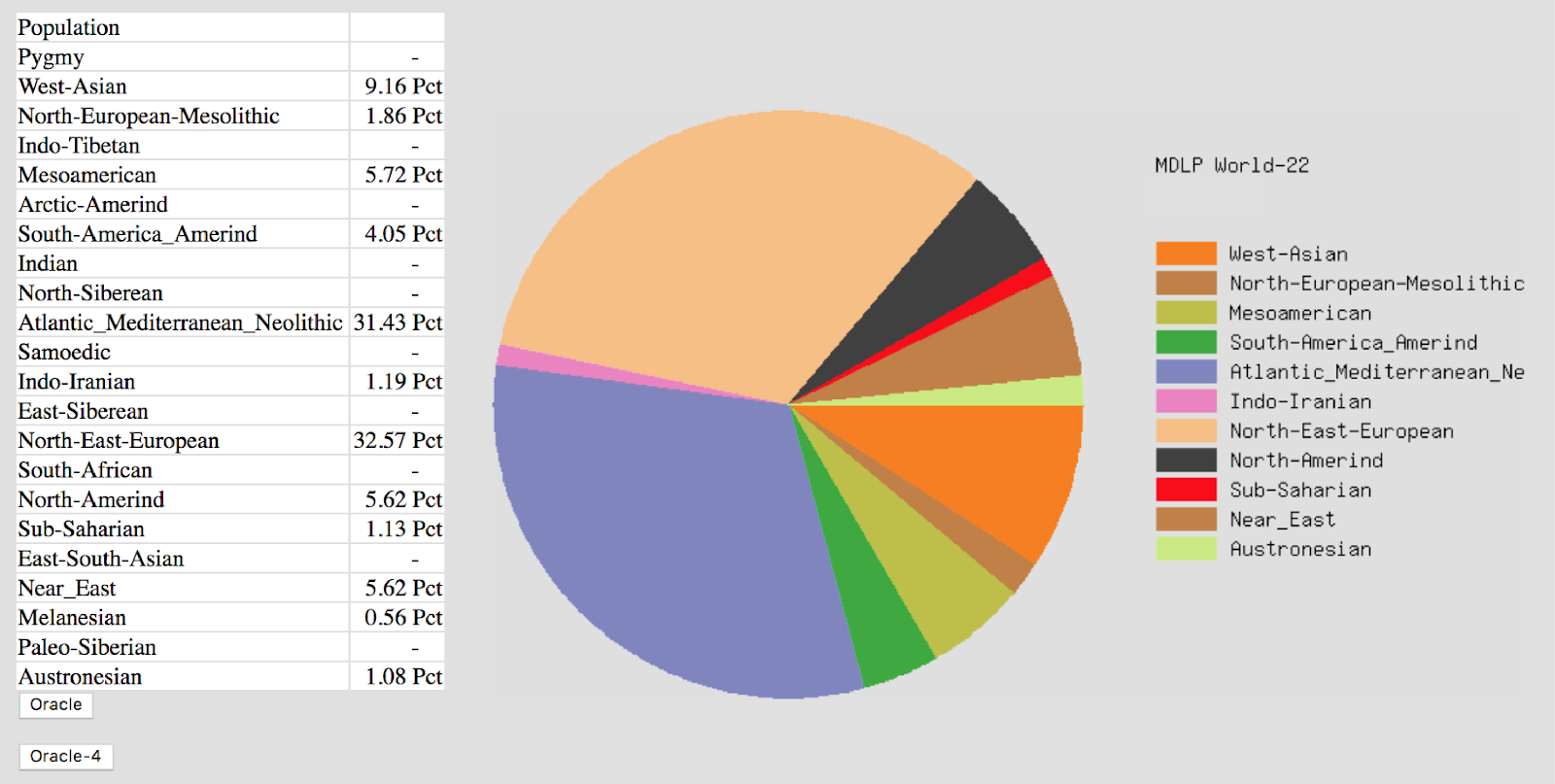
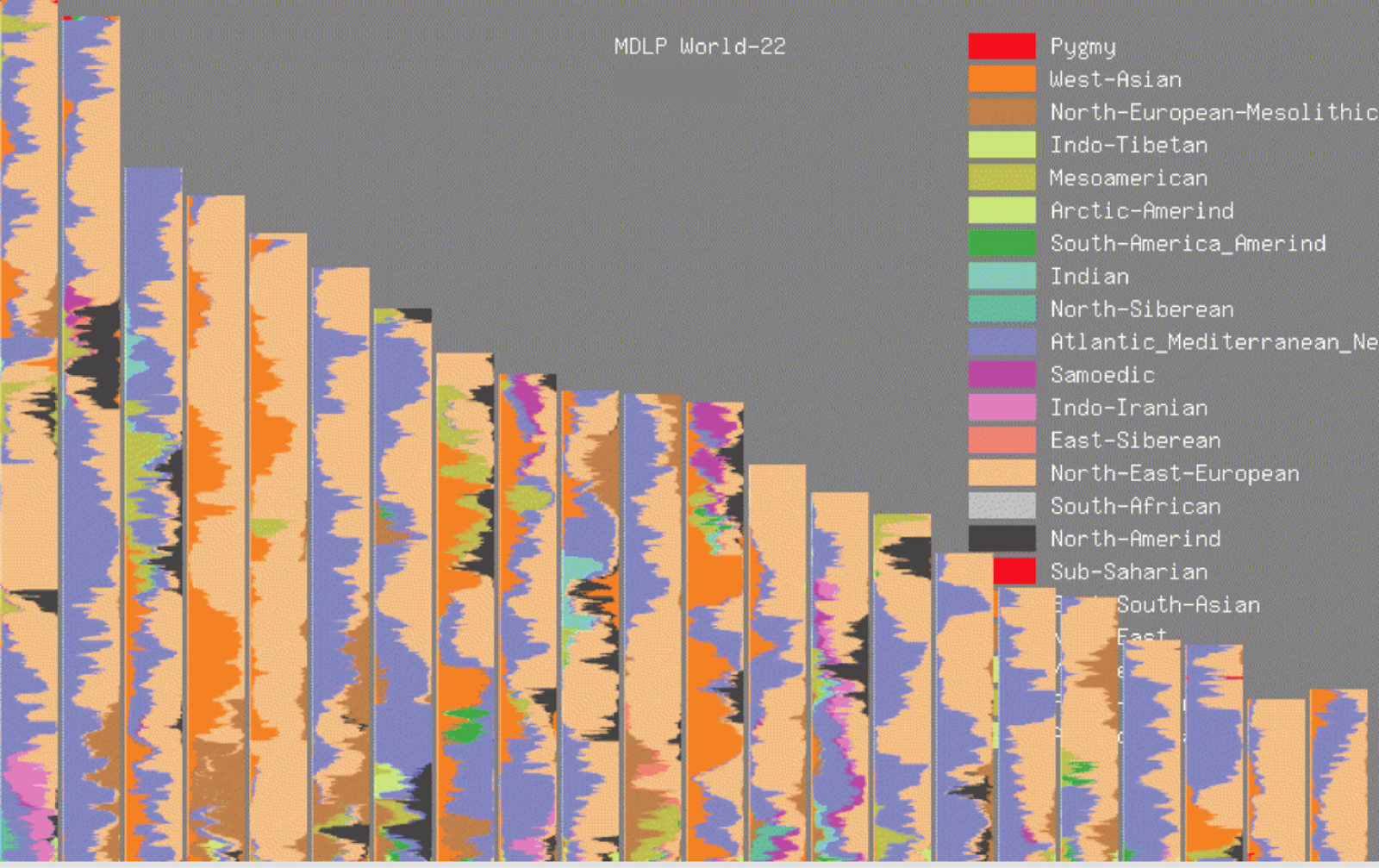
The pie chart is useful to see what your full ancestry estimates are. The chromosome painting allows you to see which areas of your genome are from what population and helps show a petty more of the incertitude in the estimates — areas that are multiple colors might come from whatever of those populations as the populations have similar Deoxyribonucleic acid in that genomic region.
How to tell if your parents are related
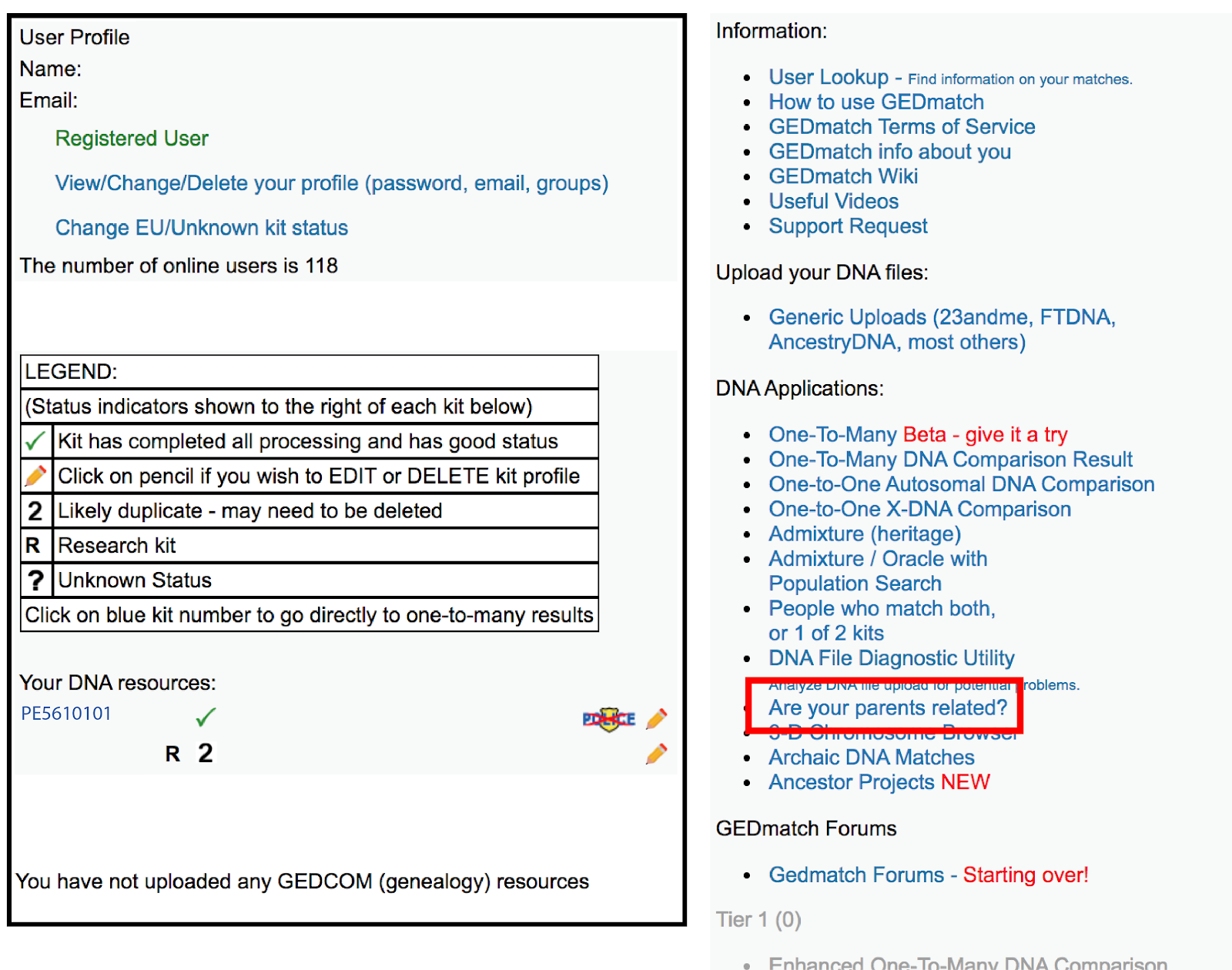
Like to how GEDmatch lets y'all notice relatives in their DNA database by matching segments of your DNA to theirs, you can check if your parents were related by looking for segments of your ain DNA that matches itself. You have 2 copies of each chromosome, one from each parent. and tin compare them to each other. If large chunks match, it'due south probable your parents share a contempo common ancestor.
Thankfully, my results were pretty irksome.
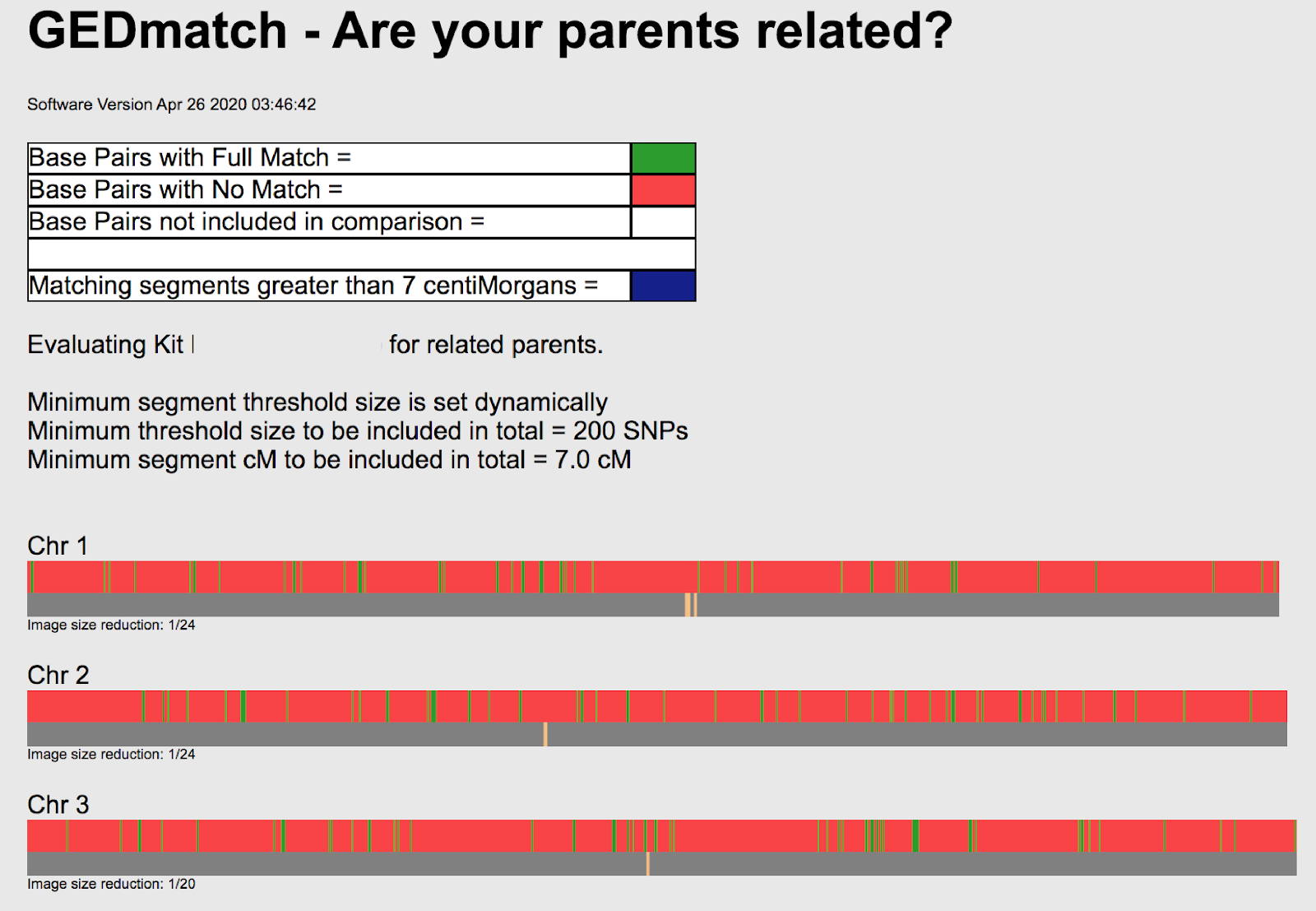
Cherry denotes that there was no match, light-green that in that location was a match, and blue that there was a long match. Some brusk matches are expected to happen by chance. Several long matches would bespeak that your parents are related.
How to check if you're related to any aboriginal humans
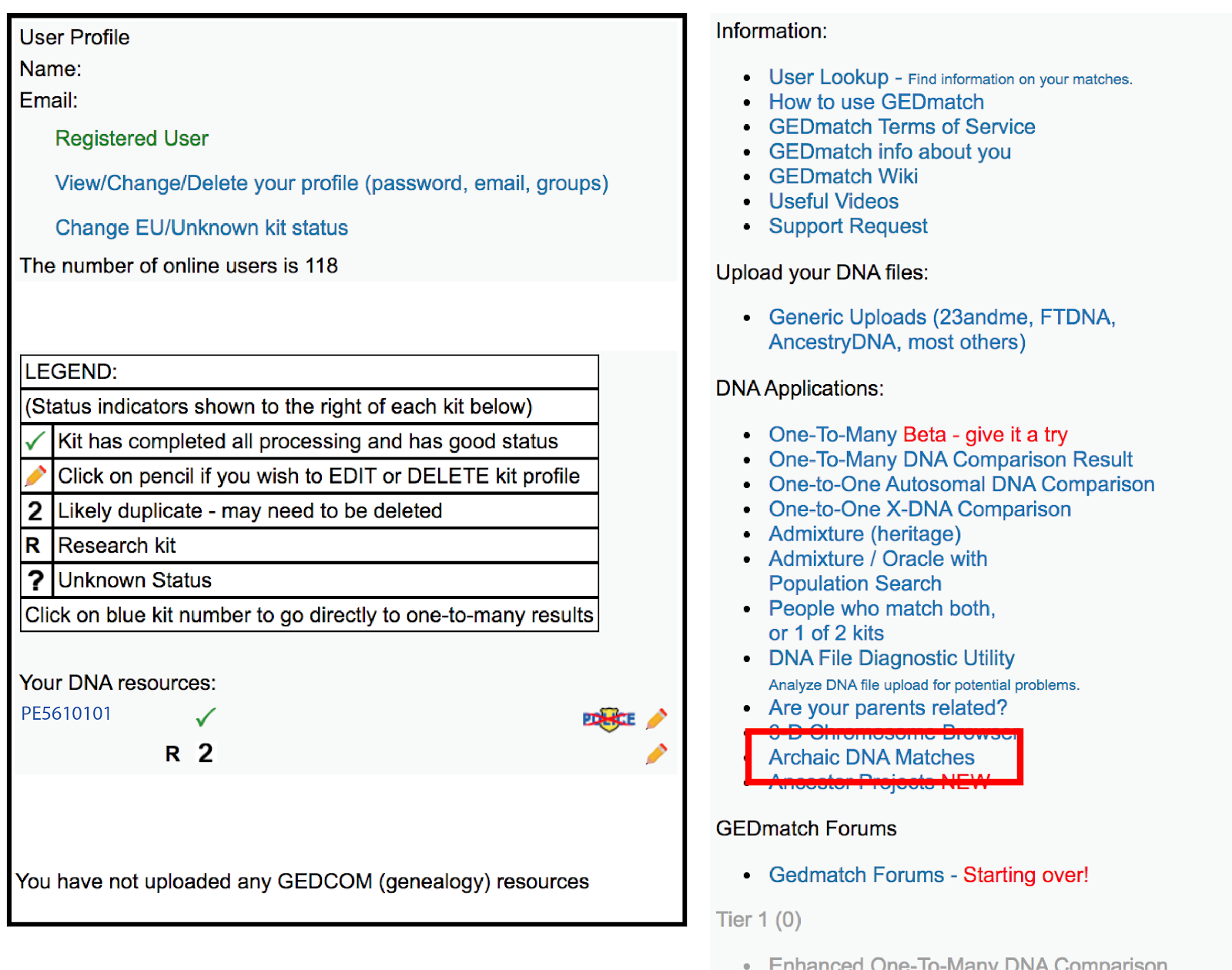
Everyone is descended from some ancient humans, simply non all ancient humans have been sequenced. Occasionally, scientists find ancient remains that still take human Dna that is in skillful plenty shape to extract genetic information.
This application works in a similar manner to the ane-to-many Deoxyribonucleic acid comparison tool that you are likely still waiting to run. It compares your Deoxyribonucleic acid to the aboriginal samples and checks if whatsoever long stretches lucifer.
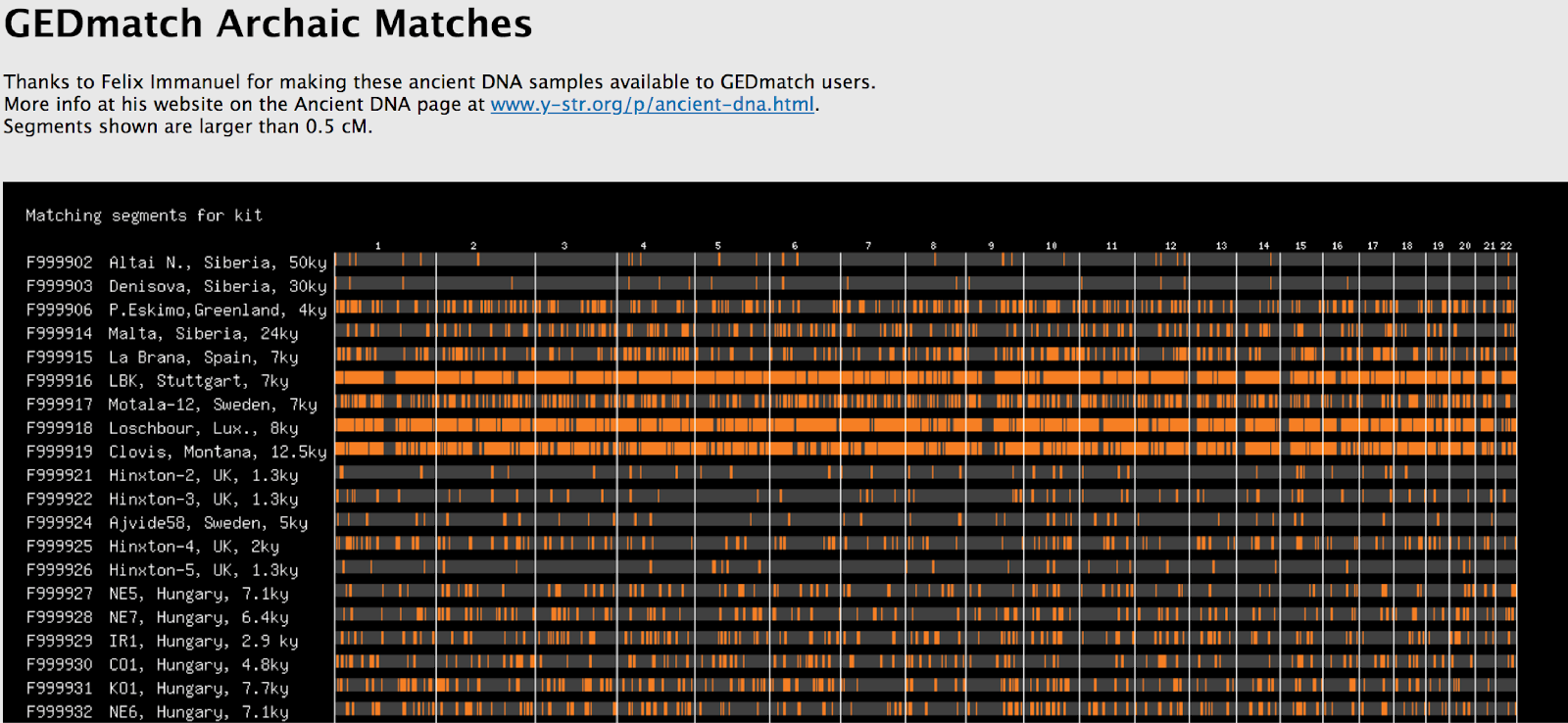
The tool lets you alter how long the matching stretch is. 0.5 cM is pretty short and there are a lot of matches. Many matches do non necessarily point that there is a close relationship. These are denoted in orangish. Each orange bar shows which part of the ancient homo'southward chromosomes match mine.
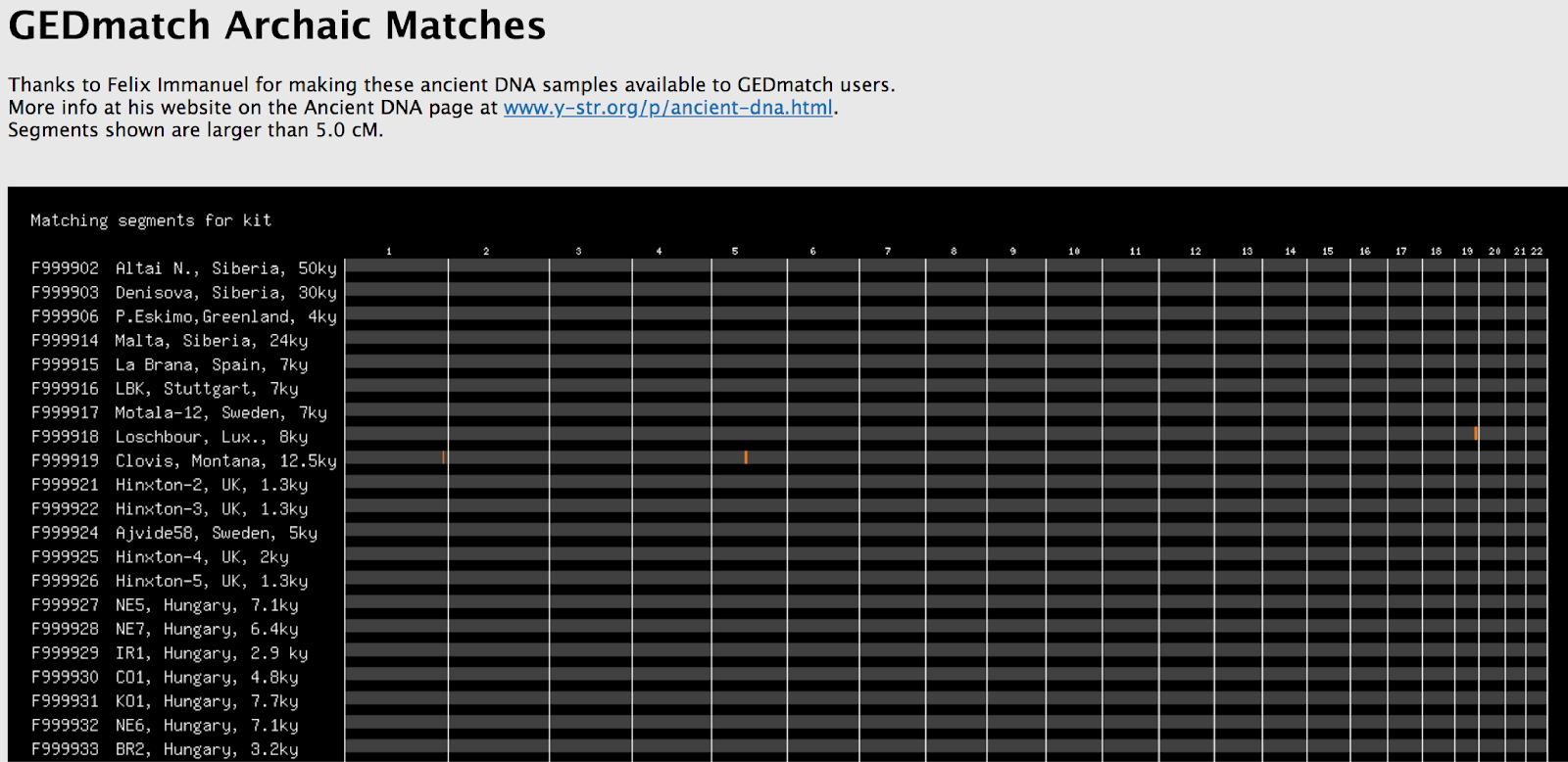
Withal, if you lot increase the stretch that needs to friction match to a larger number, hither 5cM, significantly fewer stretches lucifer. This ways I am not very closely related to these ancient humans. At that place were no matches above 6cM.
How to look at matching segments in multiple people
Rather than only comparison your chromosomes to others (one-to-many), the 3-D Chromosome Browser lets up to 9 comparisons happen at once (many-to-many).
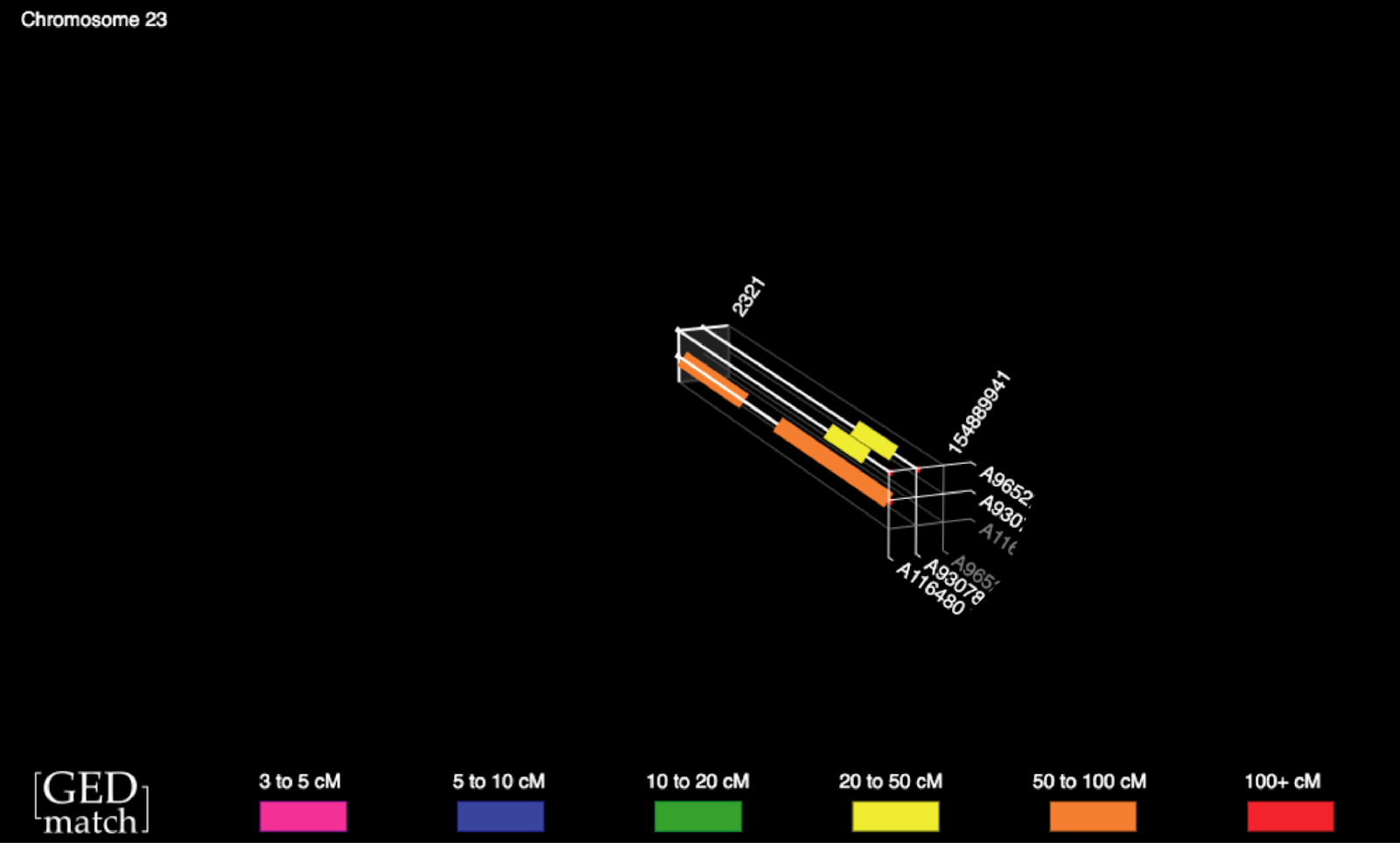
Here I'thou looking at ii individuals who are parent and child and one distantly related family member. The colored bars are the parts of the X chromosome that friction match between the ii individuals. The orange is showing that most of the Ten chromosome matches between the female parent and child.
The middle part that is non highlighted as a friction match is the centromere. In that location is a centromere in the middle of every chromosome. The centromeric DNA is very repetitive and doesn't comprise any genes. Therefore it is unremarkably not included in SNP analysis.
The mom and child likely also have matching centromeres, but since no SNPs were analyzed in that area, information technology can't be confirmed that they're the aforementioned.
The yellowish bars show the role of the Ten chromosome that matches the more than distantly related family member. This clamper is smaller since the individual is more distantly related. The clamper also matches both the mother and child, indicating that the relative is related to the child through the female parent. If the distant relative was related to the child through the father, at that place would not be a lucifer.
Y'all can utilise the 3D chromosome browser for any individuals you accept kits numbers of. However, unrelated individuals will not accept matching DNA and volition non provide very interesting plots.
How do you find kit numbers for related individuals? You apply the one-to-many tool!
How to use the one-to-many tool
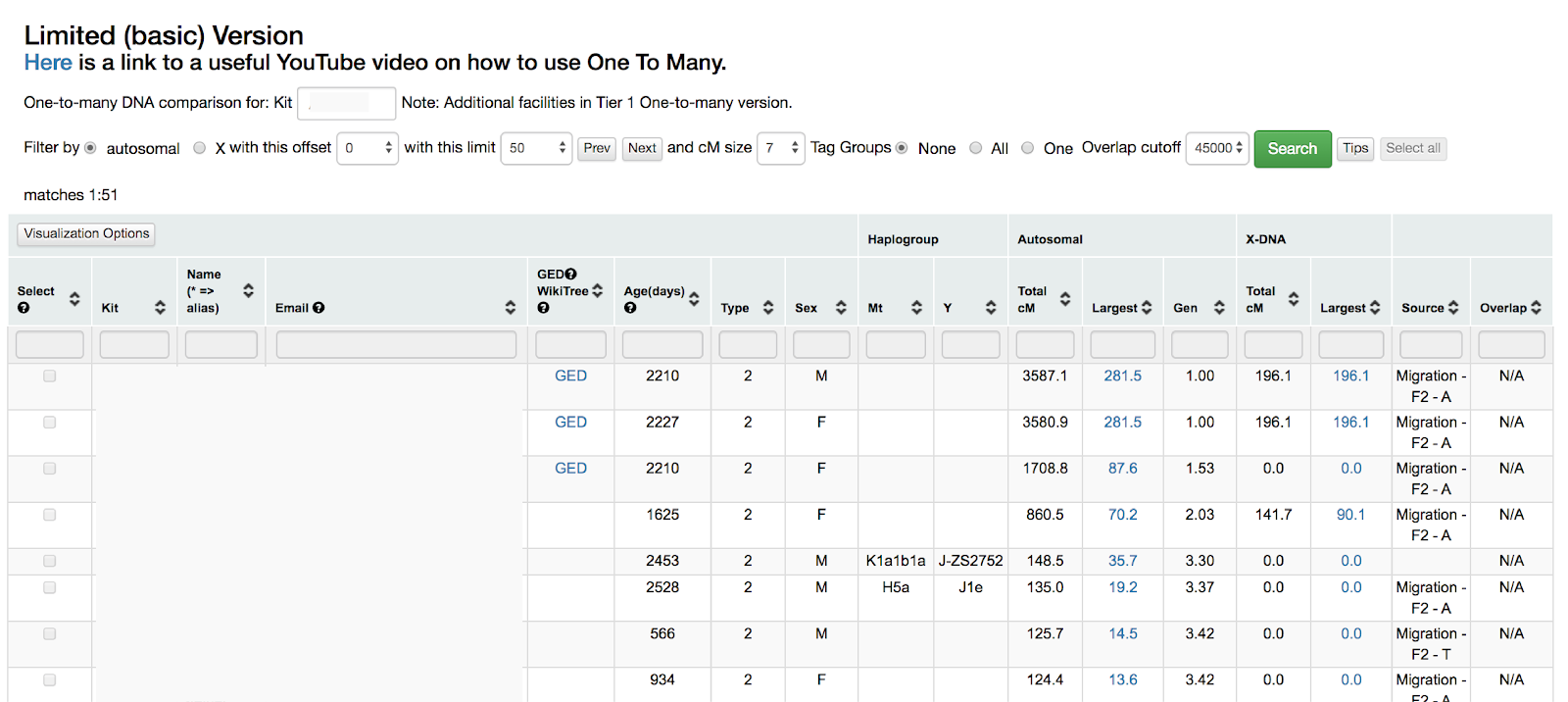
One to two days after uploading your Deoxyribonucleic acid information, you tin type in your (or anyone's) kit number at the height and hitting search. This will pull upwards the individuals that share segments of Deoxyribonucleic acid with you, likewise known as your family unit.
The first column is the kit number, which uniquely identifies the Deoxyribonucleic acid upload and permits whatever user to echo any assay using that kit number instead of their own. This ways yous can accept the kit number y'all detect here and plug information technology into the tools described above: you tin can observe out their admixture/heritage, if their parents were related, or compare their chromosomes to anyone else who'south kit number you copy and paste.
The 2nd column is any alias the user chooses to apply for that kit and the third is the user's e-mail. The user might non be the person the DNA is from. You lot shouldn't assume that that email belongs to your relative, only that it belongs to someone with say-so to upload your relative's Dna information.
After the user'south data is "GED". The GED in GEDmatch stands for GEnealogical Data. This comes from the GEDCOM (GEnealogical Data COMmunication) file format.
If you have a detailed family unit tree in genealogical inquiry software, information technology can be exported in GEDCOM format and uploaded to GEDmatch. This will allow yous to link family unit trees using the relatedness characteristic in GEDmatch's i-to-many tool. If a kit has a GEDCOM entry associated with it, it will show up as a link in this column.
Age in days refers to how long ago the kit was uploaded. Blazon describes. Sex is a binary Male or Female that the user indicated when uploading the kit. Other entries the user could have indicated are the haplogroups: Mt and Y.
Mt is brusk for mitochondria. Mitochondria are passed down from mother to kid and don't recombine, or fragment with each generation, like most of the genome does. Information technology allows people to trace their lineage directly through their mothers.
Y is similar to Mt but just for males. Only the very ends of the Y chromosome are able to recombine with the X chromosome, meaning nigh of the Y chromosome is passed downwards from father to son intact. This permits men to trace their lineage through their fathers.
GEDmatch will not tell y'all your haplogroup, but you may be able to figure it out if your relatives have their haplogroup data. If you share a mutual maternal ancestor, y'all have the aforementioned Mt haplogroup. If you are male and share a common paternal ancestor as some other male, then you have the same Y haplogroup.
Adjacent is the "Total cM" of the match. CentiMorgans are a measurement of DNA length that factors in how oftentimes sure spots recombine. 2 columns later is "Largest" which states the longest segment that matches between two individuals.
A "Generations" column gives an estimate for the number of generations apart ii individuals are. 1 represents a parent-child relationship, i.2 is sibling, 1.4 is half-sibling, uncle, or grandparent. 2 would be a cousin equally the last mutual antecedent was two generations agone, 2.vi would exist a outset cousin once removed, 3 would exist the 2nd cousin with the concluding common ancestor 3 generations ago. The prediction breaks downward over iv.
The example individual has two first degree relatives, either parents or children, ane 1.5 degrees relative, such every bit an aunt, and a second-caste relative, likely a cousin. My own results were all beyond 4th-degree relatives.
Source states the company the genomic data was generated past or that the data was migrated (transferred) over from the old GEDmatch site. The power to pull from dissimilar DNA testing kits one of the original benefits of GEDmatch. If a user wants to search for family members, they do not have to buy both Ancestry and 23andMe kits. The user tin can search through all uploaded Deoxyribonucleic acid data regardless of the Deoxyribonucleic acid testing service.
The "Overlap" cavalcade describes how many SNPs were actually compared. This is not performed for migrated kits. The new genesis organization does non demand the kits to accept tested the same exact SNPs in order to say that two individuals are related. Even so, more SNPs that straight match means more certainty in the lucifer.
How to iterate with GEDmatch
A lot of the fun of GEDmatch is beingness able to wait at the connections betwixt people. If plenty of your relatives have uploaded their data, you lot can notice them, come across which are related to each other, and build out your family tree. Once you lot take constitute the kit numbers of people related to you, you lot can perform any analysis on that private that you would have done on yourself. This can allow you to pinpoint where different parts of your heritage came from.
Even if you don't have any close relatives, you can notice kit numbers of strangers and find their family connections and learn about their family history and heritage. This tin can exist enjoyable in a nosey fashion but, remember, anyone else can do the same with your data.
How to delete your data from GEDmatch
To remove your data from GEDmatch, click on the pencil next to the kit information on the home page.
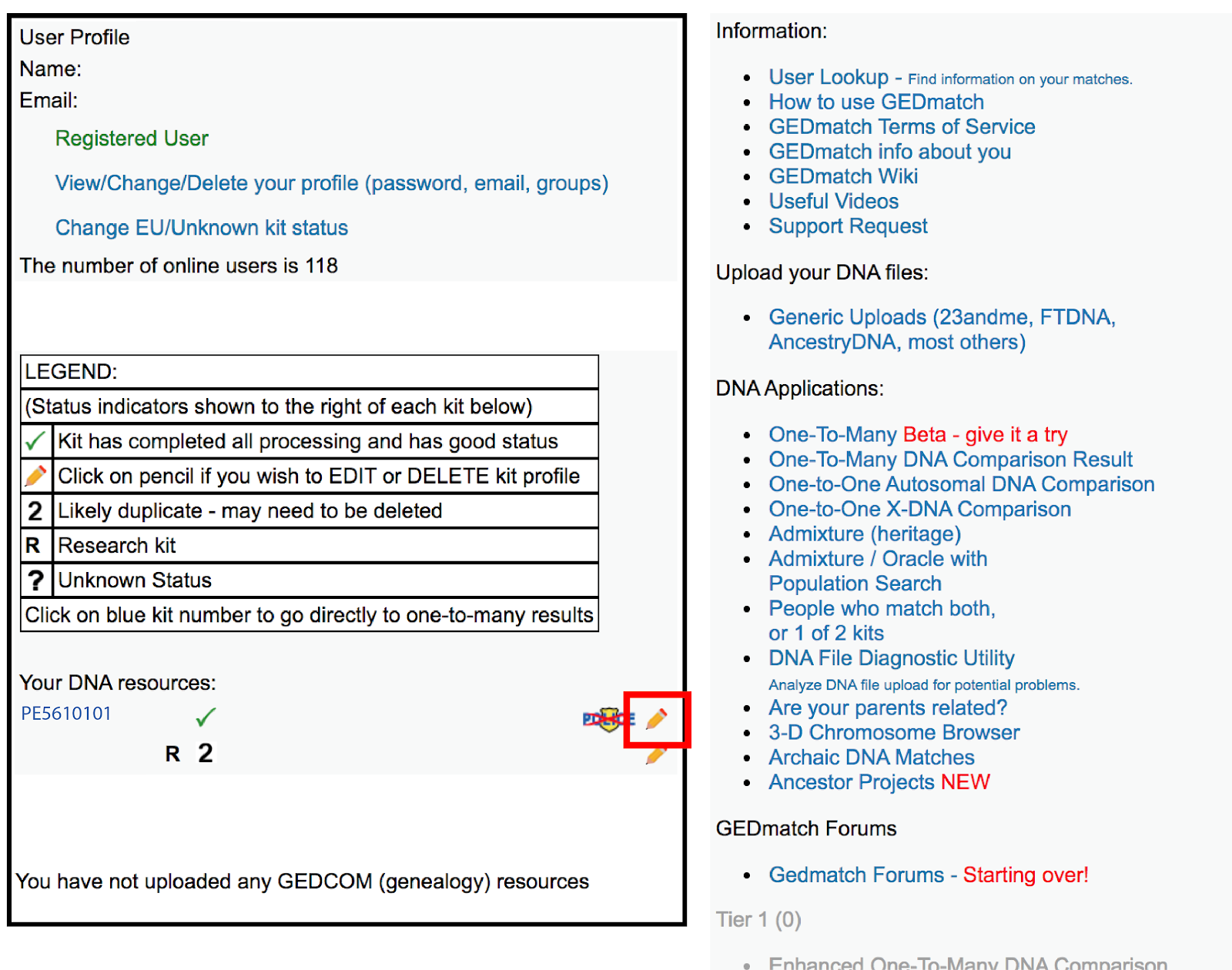
You lot will be brought to the "Kit Profile Management" folio. This folio lets yous update any of the information supplied for your kit.
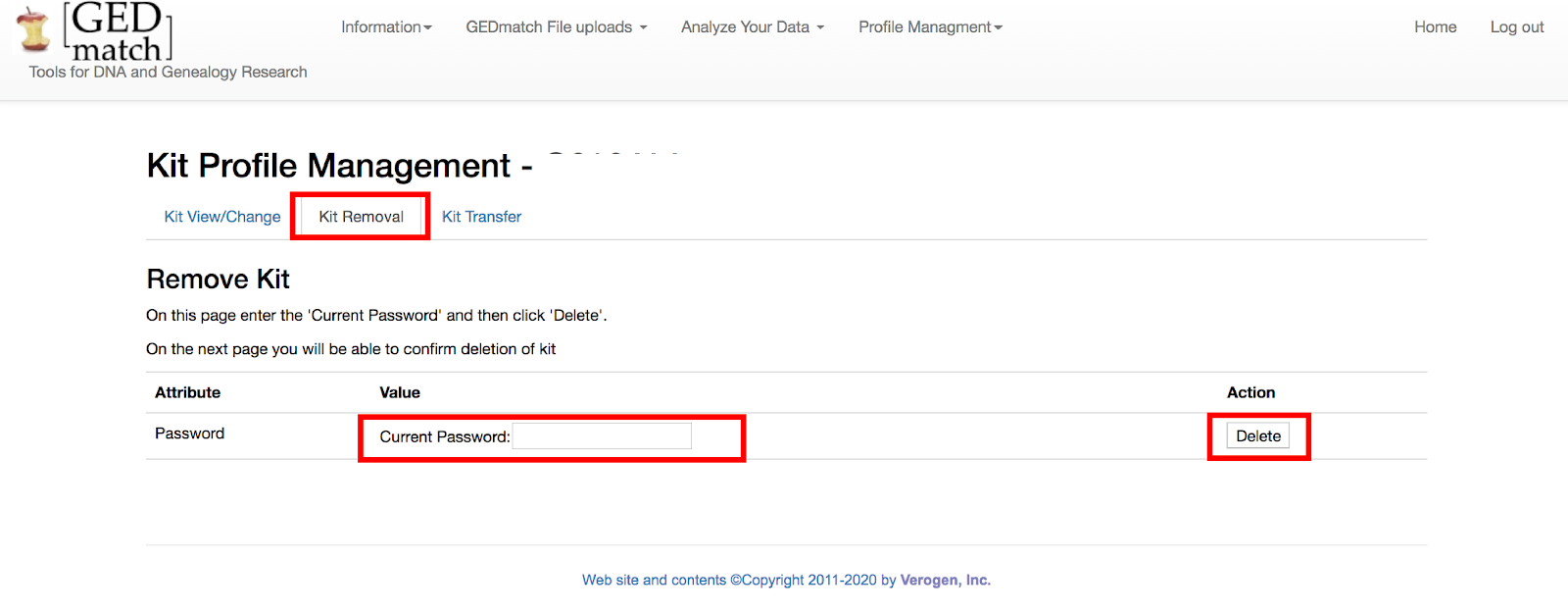
The second tab reads "Kit Removal". If yous click on it you'll be brought to the page shown below. Enter your countersign and click delete.
GEDmatch FAQ
What is GEDmatch? What does GEDmatch do?
GEDmatch is a genetic genealogy site that lets users upload their DNA profiles from other companies and discover relatives.
How to employ GEDmatch?
A user creates a contour and uploads their DNA information in the "23andMe" format. GEDmatch Genesis's 1-to-many tool takes up to 2 days to run, but then users can come across which of the 1.3 one thousand thousand individuals in the database are about closely related to them.
Is GEDmatch safe?
GEDmatch is currently owned by Verogen, a forensic genomics visitor. Users tin opt-out of having their information screened for law enforcement purposes, but the information may still be turned over if subpoenaed.
How to upload to GEDmatch?
GEDmatch has a portal that allows a user to upload data in the "23andMe" format, a standard format for many SNP based straight to consumer Dna testing companies.
How to utilise GEDmatch admixture?
Admixture analysis can be performed past entering the kit number, selecting the advisable project to compare the Deoxyribonucleic acid to, and selecting a visualization type.
What does GEDmatch stand for?
The GED in GEDmatch stands for GEnealogical Data. This comes from the GEDCOM (GEnealogical Data COMmunication) file format.
Who owns GEDmatch?
GEDmatch is endemic past Verogen, a company that helps forensic laboratories apply adjacent-generation sequencing.
How to find haplogroup on GEDmatch?
GEDmatch volition not tell you lot your haplogroup merely y'all may be able to find a maternal relative with a documented MT haplogroup or a paternal relative with a documented Y haplogroup.
What is GEDmatch Genesis?
GEDmatch Genesis is a tool that allows the user'due south Deoxyribonucleic acid profiles to be compared even if the Dna test was performed by different companies. Information technology does not require the exact same SNPs to be tested to detect matches.
Is GEDmatch authentic?
GEDmatch'south admixture/heritage tool allows the user to pick the projection they desire to compare their DNA to. The different projects will produce different results for ancestry.
Is GEDmatch free?
Many of GEDmatch'southward features are complimentary, including GEDmatch Genesis' cadre one-to-many matching tool. Additional features are $ten/month.
What is WHG on GEDmatch?
WHG stands for Westwardestern European Hunter-Gatherer, which is one of the samples of ancient Dna in puntDNAL that users can compare their beginnings to.
Did you like this tutorial? You lot might find these tutorial useful every bit well:
- Our review of GEDmatch
- How to download your 23andMe and AncestryDNA data?
- How to use the Nebula Library?
- How to use ClinVar?
- How to explore your genomic information?
- DNA testing during pregnancy?
Source: https://nebula.org/blog/gedmatch-tutorial/
0 Response to "How Do You Read Gedmatch Dna Results"
Post a Comment