Which Term Describes a Ruler in Name Only Who Can Be Manipulated by an Outside Force?

A dictator is a politico who possesses absolute power. A dictatorship is a land ruled past one dictator or by a small clique.[i] The discussion originated equally the title of a Roman dictator elected by the Roman Senate to rule the democracy in times of emergency (see Roman dictator and justitium).[2]
Like the term tyrant, and to a lesser degree despot, dictator came to be used almost exclusively as a not-titular term for oppressive rule. In modern usage the term dictator is by and large used to describe a leader who holds or abuses an extraordinary corporeality of personal power. Dictatorships are oft characterised past some of the post-obit: break of elections and civil liberties; proclamation of a land of emergency; rule past decree; repression of political opponents; not abiding by the rule of law procedures, and cult of personality. Dictatorships are often one-party or dominant-party states.[3] [4]
A wide variety of leaders coming to power in dissimilar kinds of regimes, such as one-party states, ascendant-party states, and civilian governments nether a personal dominion, have been described equally dictators.
Etymology [edit]
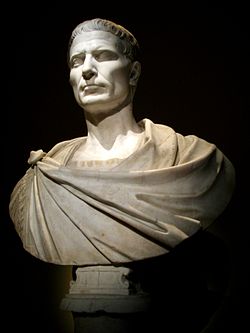
Julius Caesar outmaneuvered his opponents in ancient Rome to install himself as dictator for life.
Originally an emergency legal appointment in the Roman Republic and the Etruscan culture, the term Dictator did not have the negative meaning it has now.[5] A Dictator was a magistrate given sole power for a limited duration. At the end of the term, the Dictator'south power was returned to normal Consular rule, though not all dictators accustomed a render to power sharing.
The term started to get its mod negative pregnant with Cornelius Sulla's ascension to the dictatorship following Sulla's ceremonious war, making himself the get-go Dictator in Rome in more than a century (during which the part was ostensibly abolished) every bit well equally de facto eliminating the time limit and need of senatorial acclamation. He avoided a major constitutional crisis by resigning the office after about one year, dying a few years subsequently. Julius Caesar followed Sulla's example in 49 BC and in Feb 44 BC was proclaimed Dictator perpetuo, "Dictator in perpetuity", officially doing away with whatsoever limitations on his power, which he kept until his assassination the following calendar month.
Following Caesar's bump-off, his heir Augustus was offered the championship of dictator, simply he declined information technology. Later successors as well declined the title of dictator, and usage of the title presently diminished among Roman rulers.
The term comes from Latin 'Dictator', having same meaning as in English language, originating in 'dicio': 'exert authority', 'brand a decision'.
Modern era [edit]

2017 Democracy Index by The Economist in which countries marked in different shades of cerise of are considered undemocratic, with many beingness dictatorships.[half dozen]
Equally late as the second half of the 19th century, the term dictator had occasional positive implications. For case, during the Hungarian Revolution of 1848, the national leader Lajos Kossuth was frequently referred to as dictator, without any negative connotations, by his supporters and detractors alike, although his official title was that of regent-president.[seven] When creating a provisional executive in Sicily during the Expedition of the Thousand in 1860, Giuseppe Garibaldi officially causeless the title of "Dictator" (see Dictatorship of Garibaldi). Shortly subsequently, during the 1863 January Uprising in Poland, "Dictator" was too the official championship of four leaders, the first beingness Ludwik Mierosławski.
Past that time, all the same, the term dictator assumed an invariably negative connotation. In pop usage, a dictatorship is often associated with brutality and oppression. Equally a result, it is often as well used as a term of corruption against political opponents. The term has also come up to be associated with megalomania. Many dictators create a cult of personality around themselves and they have also come up to grant themselves increasingly grandiloquent titles and honours. For example, Idi Amin Dada, who had been a British army lieutenant prior to Republic of uganda'southward independence from Uk in October 1962, later styled himself "His Excellency, President for Life, Field Marshal Al Hadji Dr.[A] Idi Amin Dada, VC,[B] DSO, MC, Conqueror of the British Empire in Africa in General and Uganda in Particular".[8] In the moving picture The Great Dictator (1940), Charlie Chaplin satirized not only Adolf Hitler merely the institution of dictatorship itself.
Benevolent dictatorship [edit]
A benevolent dictatorship refers to a regime in which an authoritarian leader exercises absolute political power over the state only is perceived to do so with the regard for benefit of the population equally a whole, standing in contrast to the decidedly malevolent stereotype of a dictator. A benevolent dictator may allow for some economic liberalization or democratic controlling to exist, such as through public referendums or elected representatives with limited power, and ofttimes makes preparations for a transition to 18-carat democracy during or after their term. It might exist seen as a republic a form of enlightened despotism. The characterization has been applied to leaders such as Ioannis Metaxas of Greece (1936–41), Josip Broz Tito of Yugoslavia (1953–80),[9] and Lee Kuan Yew of Singapore (1959–90).[ten]
Military roles [edit]
The association betwixt a dictator and the military is a common one; many dictators take great pains to emphasize their connections with the military and they often wear military machine uniforms. In some cases, this is perfectly legitimate; Francisco Franco was a general in the Spanish Army before he became Principal of State of Spain;[11] Manuel Noriega was officially commander of the Panamanian Defense Forces. In other cases, the clan is mere pretense.
Crowd manipulation [edit]
Some dictators have been masters of crowd manipulation, such equally Mussolini and Hitler.[ commendation needed ] Others were more prosaic speakers, such every bit Stalin and Franco. Typically the dictator'due south people seize control of all media, censor or destroy the opposition, and give strong doses of propaganda daily, frequently built around a cult of personality.[12]
Mussolini and Hitler used similar, modest titles referring to them as "the Leader". Mussolini used "Il Duce" and Hitler was mostly referred to as "der Führer", meaning 'Leader' in German language linguistic communication. Franco used a similar title "El Caudillo" ("the Head", 'the chieftain')[thirteen] and for Stalin his adopted name became synonyms with his part every bit the absolute leader. For Mussolini, Hitler, and Franco, the use of modest, non-traditional titles displayed their accented ability fifty-fifty stronger equally they did not need any, not even a historic legitimacy either.

Country ratings for 2022 from Freedom House's Freedom in the World 2017 [14]
Free (86)
Partly Free (59)
Non Free (l)
Criticism [edit]
The usage of the term dictator in western media has been criticized as "Lawmaking for Government Nosotros Don't Like". Leaders that would generally exist considered disciplinarian but are allied with the US such as Paul Biya or Nursultan Nazarbayev are rarely referred to as "dictators", while leaders of countries opposed to US policy such every bit Nicolas Maduro or Bashar Al-Assad have the term applied much more than liberally.[xv]
Modern usage in formal titles [edit]

Because of its negative and pejorative connotations, modern disciplinarian leaders very rarely (if ever) employ the term dictator in their formal titles, instead they near oftentimes simply accept title of president. In the 19th century, even so, its official usage was more mutual:[xvi]
- The Dictatorial Government of Sicily (27 May – 4 November 1860) was a conditional executive regime appointed by Giuseppe Garibaldi to rule Sicily. The government concluded when Sicily'south annexation into the Kingdom of Italian republic was ratified by plebiscite.[17]
- Romuald Traugutt was Dictator of Poland from 17 October 1863 to x April 1864.[eighteen]
- The Dictatorial Government of the Philippines (1898–1898) was an insurgent government in the Philippines which was headed by Emilio Aguinaldo with formally holding the title of dictator.[19] The dictatorial government was superseded by the revolutionary government with Aguinaldo every bit president.
Man rights abuses [edit]
Over time, dictators take been known to employ tactics that violate human rights. For instance, under the Soviet dictator Joseph Stalin, government policy was enforced by hole-and-corner police and the Gulag system of prison labour camps. Most Gulag inmates were not political prisoners, although meaning numbers of political prisoners could exist found in the camps at any i time. Information collected from Soviet archives gives the death price from Gulags as ane,053,829.[20] Other human rights abuses by the Soviet state included human being experimentation, the employ of psychiatry as a political weapon and the denial of liberty of organized religion, assembly, speech and association. Similar crimes were committed during Mao Zedong'due south rule over the People's Republic of Cathay during China's Cultural Revolution, where Mao set out to purge dissidents, primarily through the use of youth groups strongly committed to his cult of personality.[21]
Some dictators have been associated with genocide on certain races or groups; the most notable and wide-reaching example is the Holocaust, Adolf Hitler's genocide of eleven million people, half dozen 1000000 of which were Jews.[22] Later on in Autonomous Kampuchea, Political leader Pot and his policies killed an estimated one.7 million people (out of a population of 7 meg) during his 4-year dictatorship.[23] Every bit a upshot, Political leader Pot is sometimes described equally "the Hitler of Cambodia" and "a genocidal tyrant".[24]
The International Criminal Courtroom issued an abort warrant for Sudan'southward military dictator Omar al-Bashir over alleged state of war crimes in Darfur.[25]
Run across likewise [edit]
- Authoritarian personality
- Benevolent dictator for life
- Chinese Communist Party
- Greek junta
- Dictator novel
- Emergency powers
- List of political leaders who suspended the constitution
- Nazi Political party
- Strongman (politics)
- Supreme Leader
- Democracy Index
- Workers' Political party of Korea
References [edit]
Notes [edit]
- A ^ He conferred a doctorate of law on himself from Makerere University.[26]
- B ^ The Victorious Cross (VC) was a medal made to emulate the British Victoria Cross.[27]
Citations [edit]
- ^ "Dictatorship" at Merriam Webster (2019) Archived 2020-01-18 at the Wayback Machine
- ^ "dictator – Definition from the Merriam-Webster Online Dictionary". Merriam-Webster. Archived from the original on sixteen May 2008. Retrieved one August 2008.
- ^ Papaioannou, Kostadis; vanZanden, January Luiten (2015). "The Dictator Event: How long years in office affect economic development". Journal of Institutional Economic science. 11 (one): 111–139. doi:10.1017/S1744137414000356. S2CID 154309029.
- ^ Olson, Mancur (1993). "Dictatorship, Commonwealth, and Development". American Political Science Review. 87 (3): 567–576. doi:x.2307/2938736. JSTOR 2938736.
- ^ Le Glay, Marcel. (2009). A history of Rome. Wiley-Blackwell. ISBN978-1-4051-8327-seven. OCLC 760889060. Archived from the original on 2020-07-25. Retrieved 2020-05-21 .
- ^ "Democracy Index 2022 – Economist Intelligence Unit" (PDF). EIU.com. Archived from the original (PDF) on xviii February 2018. Retrieved 17 Feb 2018.
- ^ Macartney, Carlile Aylmer (September 15, 2020). Lajos Kossuth. Encyclopedia Britannica. Archived from the original on November 1, 2020. Retrieved October 31, 2020.
- ^ Keatley, Patrick (18 August 2003). "Obituary: Idi Amin". The Guardian. London. Archived from the original on 2013-12-05. Retrieved 2008-03-18 .
- ^ Shapiro, Susan; Shapiro, Ronald (2004). The Curtain Rises: Oral Histories of the Fall of Communism in Eastern Europe. McFarland. ISBN978-0-7864-1672-i. Archived from the original on 2021-05-12. Retrieved 2019-01-19 .
"...All Yugoslavs had educational opportunities, jobs, food, and housing regardless of nationality. Tito, seen by most every bit a chivalrous dictator, brought peaceful co-being to the Balkan region, a region historically synonymous with factionalism." - ^ Miller, Matt (2012-05-02). "What Singapore tin teach us". The Washington Post. ISSN 0190-8286. Archived from the original on 2016-03-11. Retrieved 2015-xi-25 .
- ^ Thomas, Hugh (1977). The Spanish Civil War. pp. 421–424. ISBN978-0-06-014278-0.
- ^ Morstein, Marx Fritz; et al. (March 2007). Propaganda and Dictatorship. Princeton Upwardly. ISBN978-1-4067-4724-ix.
- ^ Hamil, Hugh M., ed. (1992). "Introduction". Caudillos: Dictators in Spanish America. Academy of Oklahoma Printing. pp. 5–vi. ISBN978-0-8061-2428-5.
- ^ Freedom in The World 2022 – Populists and Autocrats: The Dual Threat to Global Republic Archived 2017-07-27 at the Wayback Machine by Liberty Business firm, January 31, 2017
- ^ "Dictator: Media Code for 'Regime Nosotros Don't Like'". Fair. 2019-04-11. Archived from the original on 2021-04-16. Retrieved 2021-04-07 .
- ^ Moisés Prieto, ed. Dictatorship in the Nineteenth Century: Conceptualisations, Experiences, Transfers (Routledge, 2021).
- ^ Cesare Vetter, "Garibaldi and the dictatorship: Features and cultural sources." in Dictatorship in the Nineteenth Century (Routledge, 2021) pp. 113-132.
- ^ Stefan Kieniewicz, "Smoothen Society and the Insurrection of 1863." By & Present 37 (1967): 130-148.
- ^ "The Start Philippine Republic". National Historical Committee. seven September 2012. Archived from the original on 27 Jan 2017. Retrieved 26 May 2018.
On June twenty, Aguinaldo issued a decree organizing the judiciary, and on June 23, again upon Mabini'southward advice, major changes were promulgated and implemented: change of government from Dictatorial to Revolutionary; modify of the Executive title from Dictator to President
- ^ "Gulag Prisoner Population Statistics from 1934 to 1953." Wasatch.edu. Wasatch, n.d. Web. 16 July 2016: "According to a 1993 study of Soviet archival data, a total of ane,053,829 people died in the Gulag from 1934 to 1953. However, taking into business relationship that it was common practice to release prisoners who were either suffering from incurable diseases or on the betoken of death, the actual Gulag death toll was somewhat college, amounting to 1,258,537 in 1934–53, or 1.6 million deaths during the whole period from 1929 to 1953.."
- ^ "Remembering the night days of China's Cultural Revolution". South China Morning time Post. 18 August 2012. Archived from the original on 2018-06-09. Retrieved 2021-07-xv .
- ^ "The Holocaust". The National WWII Museum | New Orleans. Archived from the original on 2021-07-fifteen. Retrieved 2021-07-15 .
- ^ ""Top 15 Toppled Dictators". Fourth dimension. 20 October 2011. Archived from the original on 2013-08-24. Retrieved four March 2017.
- ^ William Branigin, Architect of Genocide Was Unrepentant to the Cease Archived 2013-05-09 at the Wayback Automobile The Washington Post, April 17, 1998
- ^ "Sudanese dictator Omar al-Bashir faces war crimes charges Archived 2018-05-16 at the Wayback Machine". The Daily Telegraph. July 14, 2008.
- ^ "Idi Amin: a byword for brutality". News24. 2003-07-21. Archived from the original on 2008-06-05. Retrieved 2007-12-02 .
- ^ Lloyd, Lorna (2007). Diplomacy with a Difference: The Republic Office of Loftier Commissioner, 1880–2006. University of Michigan: Martinus Nijhoff. p. 239. ISBN978-90-04-15497-1.
Further reading [edit]
- Acemoglu, Daron, and James A. Robinson. Economical Origins of Dictatorship and Democracy (2009), scholarly approach to comparative political economy excerpt
- Armillas-Tiseyra, Magalí. The Dictator Novel: Writers and Politics in the Global South (2019) extract
- Baehr, Peter and Melvin Richter. Dictatorship in History and Theory (2004) scholarly focus on 19c Europe.
- Ben-Ghiat, Ruth. Strongmen: Mussolini to the Present (2020) scholarly assay of xiii major dictators; excerpt
- Brooker, Paul. Defiant Dictatorships: Communist and Middle-Eastern Dictatorships in a Democratic Age (Palgrave Macmillan, 1997). extract
- Costa Pinto, António. Latin American Dictatorships in the Era of Fascism: The Corporatist Wave (Routledge, 2019) excerpt
- Crowson, Nick. Facing Fascism: The Conservative Party and the European Dictators 1935-40 (Routledge, 1997), how the Conservative authorities in Britain dealt with them.
- Dávila, Jerry. Dictatorship in South America (2013), covers Brazil, Argentina, and Chile since 1945. excerpt
- Galván, Javier A. Latin American Dictators of the 20th Century: The Lives and Regimes of 15 Rulers (2012), brief scholarly summaries; excerpt
- Hamill, Hugh Yard. Caudillos: dictators in Castilian America (U of Oklahoma Printing, 1995).
- Harford Vargas, Jennifer. Forms of Dictatorship: Power, Narrative, and Authoritarianism in the Latina/o Novel (Oxford Upward, 2017).
- Kim, Michael et al. eds. Mass Dictatorship and Modernity (2013) excerpt
- Lim, J. and K. Petrone, eds. Gender Politics and Mass Dictatorship: Global Perspectives (2010) excerpt
- Lüdtke, Alf. Everyday Life in Mass Dictatorship: Collusion and Evasion (2015) extract
- Mainwaring, Scott, and Aníbal Pérez-Liñán, eds. Democracies and Dictatorships in Latin America: Emergence, Survival, and Fall (2014) excerpt
- Moore Jr, Barrington. Social Origins of Dictatorship and Democracy: Lord and Peasant in the Making of the Mod Earth (1966) online
- Peake, Lesley. Guide To History's Worst Dictators: From Emperor Nero To Vlad the Impaler And More: Nero Accomplishments(2021) excerpt, popular
- Rank, Michael. History'south Worst Dictators: A Brusque Guide to the Well-nigh Brutal Rulers, From Emperor Nero to Ivan the Terrible (2013), pop.
- Spencer, Robert. Dictators, Dictatorship and the African Novel (Palgrave Macmillan, 2021).
- Weyland, Kurt. Revolution and Reaction: The Diffusion of Absolutism in Latin America (2019) excerpt
External links [edit]
-
 The dictionary definition of dictator at Wiktionary
 - Current Dictators of the World
- online books on dictatorship
Source: https://en.wikipedia.org/wiki/Dictator
0 Response to "Which Term Describes a Ruler in Name Only Who Can Be Manipulated by an Outside Force?"
Post a Comment