Focus on Reading Computer Eye Tracking Program
- Download executable - 2.51 MB
- Download source code - 199.24 KB
Introduction
Optics are the most important features of the man face up. So effective usage of middle movements every bit a advice technique in user-to-computer interfaces can find identify in diverse application areas.
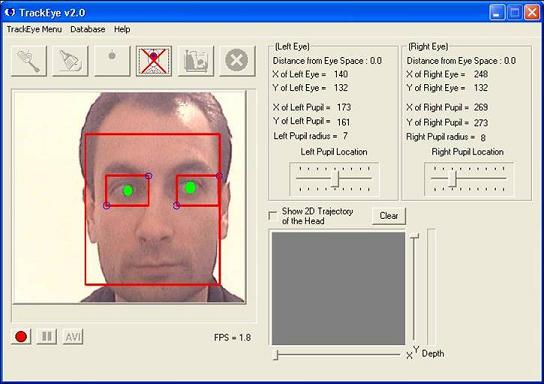
Eye tracking and the data provided past the eye features have the potential to become an interesting way of communicating with a computer in a homo-computer interaction (HCI) system. And then with this motivation, designing a existent-time eye feature tracking software is the aim of this project.
The purpose of the project is to implement a real-fourth dimension middle-feature tracker with the following capabilities:
- RealTime face tracking with scale and rotation invariance
- Tracking the centre areas individually
- Tracking eye features
- Heart gaze direction finding
- Remote controlling using heart movements
Instructions to Run and Rebuild TrackEye
Installation Instructions
- Excerpt TrackEye_Executable.zip file. Before running TrackEye_636.exe, re-create the two files SampleHUE.jpg and SampleEye.jpg to the C:\ folder. These two files are used for CAMSHIFT and Template-Matching algorithms.
- There are no other steps to exist followed by the user to run the software. At that place are no DLL dependencies equally the software was built with the DLLs statically included.
Settings to exist Done to Perform a Adept Tracking
Settings for Face & Eye Detection
Under TrackEye Menu --> Tracker Settings
- Input Source: video
- Click on Select file and select ..\Avis\Sample.avi
- Face Detection Algorithm: Haar Face up Detection Algorithm
- Check "Track also Eyes" checkBox
- Eye Detection Algorithm: Adaptive PCA
- Uncheck "Variance Check"
- Number of Database Images: 8
- Number of EigenEyes: 5
- Maximum allowable distance from eyespace: 1200
- Face width/eye template width ratio: 0.three
-
ColorSpacetype to use during PCA:CV_RGB2GRAY
Settings for Student Detection
Check "Rail optics in details" and then check "Detect also eye pupils". Click "Adjust Parameters" button:
- Enter "120" as the "Threshold Value"
- Click "Save Settings" and and so click "Close"
Settings for Serpent
Check "Bespeak eye boundary using agile snakes". Click "Settings for ophidian" button:
- Select
ColorSpaceto use:CV_RGB2GRAY - Select Elementary thresholding and enter 100 equally the "Threshold value"
- Click "Salve Settings" and and so click "Shut"
Groundwork
So far there has been a lot of work on eye detection and before the project, the previous methods were carefully studied to make up one's mind the implemented method. We can allocate studies related to center into two main categories as listed beneath:
Special Equipment Based Approaches
These type of studies utilize the necessary equipment which will give a indicate of some sort which is proportional to the position of the eye in the orbit. Various methods that are current in use are Electrooculography, Infra-Red Oculography, Scleral search coils. These methods are completely out of our project.
Image Based Approaches
Prototype based approaches perform eye detections on the images. Almost of the image based methods attempt to observe the eyes using the features of the eyes. Methods used so far are noesis-based methods, feature-based methods (colour, gradient), simple template matching, appearance methods. Another interesting method is "Deformable template matching" which is based on matching a geometrical eye template on an eye prototype past minimizing the energy of the geometrical model.
Implementation of TrackEye
The implemented projection is on three components:
- Face up detection: Performs scale invariant face detection
- Middle detection: Both optics are detected as a result of this step
- Eye feature extraction: Features of eyes are extracted at the end of this step
Face Detection
2 different methods were implemented in the projection. They are:
- Continuously Adaptive Ways-Shift Algorithm
- Haar Face up Detection method
Continuously Adaptive Mean-Shift Algorithm
Adaptive Mean Shift algorithm is used for tracking human faces and is based on robust not-parametric technique for climbing density gradients to detect the mode (meridian) of probability distributions called the mean shift algorithm. As faces are tracked in video sequences, mean shift algorithm is modified to deal with the problem of dynamically changing color probability distributions. The cake diagram of the algorithm is given below:

Haar-Face Detection Method
The 2d confront detection algorithm is based on a classifier working with Haar-Like features (namely a cascade of boosted classifiers working with Haar-like features). First of all information technology is trained with a few hundreds of sample views of a face up. Later a classifier is trained, it can be applied to a region of interest in an input paradigm. The classifier outputs a "ane" if the region is likely to show face and "0" otherwise. To search for the object in the whole image, one tin move the search window beyond the image and cheque every location using the classifier. The classifier is designed so that it can be hands "resized" in social club to be able to find the objects of interest at dissimilar sizes, which is more efficient than resizing the image itself.
Eye Detection
Two unlike methods were implemented in the project:
- Template-Matching
- Adaptive
EigenEyeMethod
Template-Matching
Template-Matching is a well-known method for object detection. In our template matching method, a standard eye pattern is created manually and given an input epitome, the correlation values with the standard patterns are computed for the eyes. The existence of an centre is determined based on the correlation values. This arroyo has the advantage of beingness simple to implement. However, it may sometimes exist inadequate for eye detection since it cannot effectively deal with variation in scale, pose and shape.
Adaptive EigenEye Method
Adaptive EigenEye Method is based on the well-known method EigenFaces. However as the method is used for eye detection nosotros named information technology as "EigenEye Method". The master idea is to decompose eye images into a pocket-sized set of characteristics feature images called eigeneyes, which may be thought of as the principal components of the original images. These eigeneyes part as the orthogonal ground vectors of a subspace called eyespace. Nevertheless we know that the eigenface method is not calibration invariant. To provide the scale invariance we can resize the heart-database once with the information gathered by the confront detection algorithm (EyeWidth / FaceWidth ? 0.35), we can provide scale-invariant detection using only 1 database.
OpenCV Functions for Object Tracking and Detection
OpenCV Library offers a lot of image processing and object tracking & detection libraries. The main office used in these projects and their usage are given below:
Sample Code for Haar-Confront Tracking
void CTrackEyeDlg::HaarFaceDetect( IplImage* img, CvBox2D* faceBox) { int scale = 2; IplImage* temp = cvCreateImage( cvSize(img->width/2,img->elevation/2), 8, 3 ); CvPoint pt1, pt2; int i; cvPyrDown( img, temp, CV_GAUSSIAN_5x5 ); #ifdef WIN32 cvFlip( temp, temp, 0 );
0 Response to "Focus on Reading Computer Eye Tracking Program"
Post a Comment